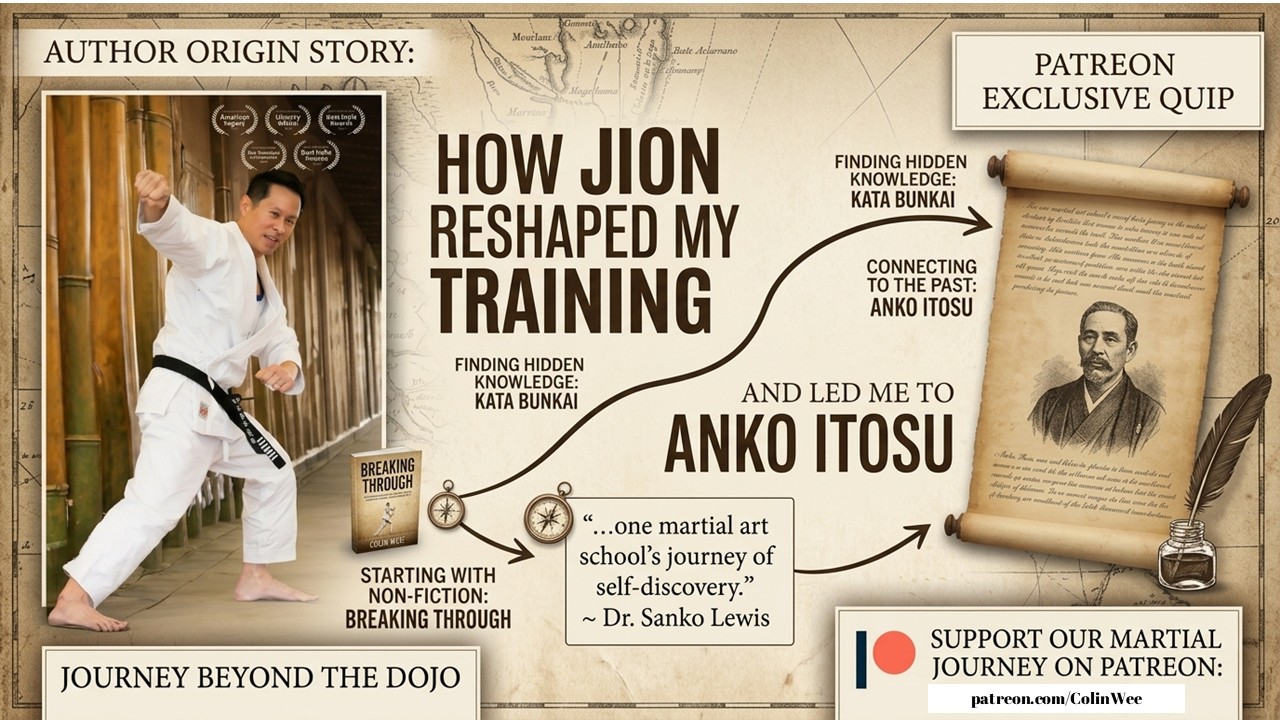
Training under Colin Wee-sensei isn’t just about throwing punches; it’s about understanding the mechanics, the history, and the intent of breathing life into every movement. Reading Anko: The Lost Scrolls of Ryukyu feels exactly like stepping onto the mats with him. It is a brilliant extension of his teachings, contextualizing the grit, strategy, and soul of our Okinawan martial heritage.
The Power of Perspective What makes this book a standout is its narrative vehicle. Instead of a dry, academic timeline of how Ryukyuan Tode evolved into modern Karate, the story is told through the eyes of Asato Anko—or “Az”—a fellow master and the closest friend of Itosu Anko. Az serves as the witty, fiercely loyal, and grounded counterweight to Itosu-sensei’s intense pragmatism and the fearsome legacy of their teacher, Matsumura Sokon-sensei.
The storytelling spans decades of political upheaval, the annexation of the Ryukyu Kingdom, and the systemic dismantling of their culture. Colin-sensei even stretches the narrative into “Celestial Ryukyu,” the afterlife where these old masters continue to watch over their students, banter, and debate the future of their art. This choice gives history a beating heart. You feel the suffocating heat of Okinawan summers, the physical toll of extreme makiwara training, and the agonizing burden Itosu-sensei carried to secretly package our lethal heritage into a public school system just to ensure it survived.
From the Dojo to the Page The insights Az shares throughout the novel mirror the very essence of what Colin-sensei drills into us. When Az describes Itosu-sensei’s structural force—how his strikes felt like colliding with the ground itself—it perfectly captures the “Power of Posture,” the routing of energy, and the kinetic mechanics we focus on. The book doesn’t romanticize martial arts; it grounds the practice in survival, adaptability, and the tactical reality of a people resisting erasure.
Contextualizing Jion Kata This rich, character-driven scaffolding pays off spectacularly in the final act, where the book shifts into a highly detailed technical breakdown of the Jion kata. Because the story has immersed us in Itosu-sensei’s mindset—his role as a high-level government administrator, his need for de-escalation, and his quiet brilliance—the kata ceases to be a sequence of dead movements.
Colin Wee-sensei breaks down Jion (meaning “Temple Sound,” invoking mercy and benevolence) not as a battlefield brawl, but as a highly sophisticated system of structural disruption. The applications detailed at the end—like dropping an adversary’s center of gravity, executing head-under takedowns, or utilizing the short-range kinetic burst of fajin—perfectly pair with the historical necessity of defending the cramped, bureaucratic halls of Shuri Castle. The storytelling proves that Jion was never about swinging harder; it was about the tactical nous to read a room, control the space, and conquer hardness with softness.
This book demands that we look beyond the surface of our forms and understand the grace, resilience, and sheer grit of the men who forged them. It is a masterclass for any martial artist who wants to know not just how we move, but why.
– Jeff Palm
2nd Dan, JDK USA Affiliate
In this historical novel, Master Wee presents an engrossing narrative of the founders of early Okinawa karate and the tumultuous history of the annexation of the Ryukyu Islands by Japan, with the evolution of modern karate.
The story begins in the mid 1800s. Readers learn about the traditional karate legends Sensei Matsumura , and Master Anko , and the one on one tradition of teaching martial arts at the time. Readers gain insights into traditional martial values, where learning fighting techniques and how to dominate an opponent go hand in hand with personal growth-that strength comes with benevolence and self control and other tools for living well.
I enjoyed learning about the development of a standardised karate curriculum and the broad introduction into the Japanese school syllabus. Master Wee, via the characters depicted in this novel, bear witness to the emerging nationalism of Imperial Japan in the early 20th century.
The story ends with an encounter between the celebrated pugilist Motobu, and Sensei Funakoshi who brought modern karate teaching to the Japanese mainland. This parable comes down firmly in support of ongoing traditional martial values , the ‘peaceful countenance” in managing conflict . Master Wee presents an entertaining and thought provoking work of historical fiction which will be of interest to all karate practitioners today.
– Dr Allan Wang
Orthopaedic Surgeon
Goju Ryu Practitioner