
Have you come across the kata Bassai Dai or Passai? Bassai has ubiquity across many Okinawan and Japanese karate systems, and even in some classical Korean martial arts. What makes it so compelling is how it prepares practitioners for unscripted, dynamic encounters — situations where nothing seems to go according to plan, especially when one is under duress.
This kata is part of the legacy system I trained in during the early 1990s through the American Karate and Taekwondo Organization. Many decades later, it then became the foundation of a book project I embarked on during the COVID pandemic of the early 2020s.
Of course, Bassai is not the only pattern that teaches tactics, adaptability, or the transformation of disadvantage into advantage. Any martial art taught by an effective instructor should cultivate those skills. So why did I spend so much time with this one kata? My obsession with Bassai was sparked by an encounter with renowned martial arts author Hanshi Bruce Clayton, PhD, in 2002. I reached out to Dr Clayton after reading Shotokan’s Secret, his compelling exploration to understand Okinawan martial art and karate pioneers of the 19th century. His research examined the purpose of their practice and revealed how they were linked to the protection of the Ryukyuan royal family.
What is Bunkai?
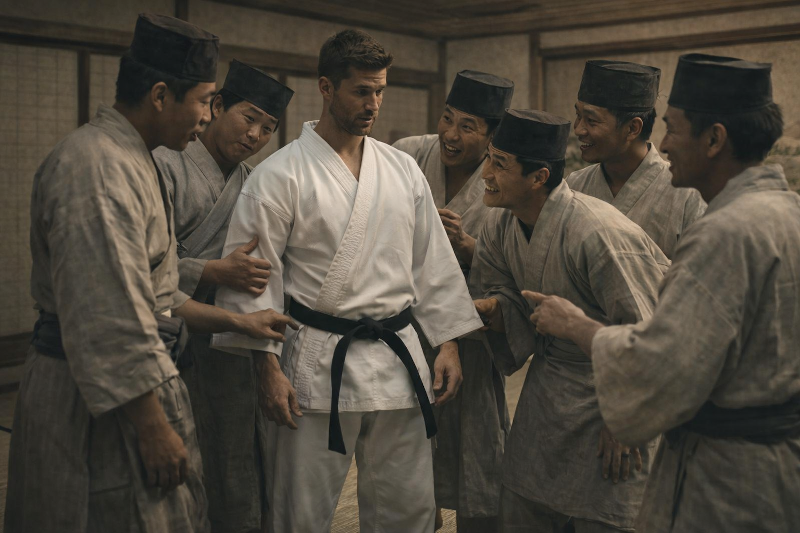
As my group and I returned time and again to Bassai’s choreography and applications, we pushed past any superficial concept of what is bunkai and discovered a training system built around anticipating resistance, expecting non‑compliance, and developing workarounds during collisions with an adversary. With the ideas Dr Clayton proffered about the inner and outer defenses of Shuri Castle, we began to see Bassai functioning as a cog in the broader security needs of the Ryukyu Kingdom. This meant the skills distilled from Bassai in the 21st century were guided directly from reflections on its functionality in 19th‑century Ryukyu.
To be honest, my focus on Bassai often came at the expense of the “normal” training done in a small martial arts school. Senior students benefitted from the deep dive into its source code, but junior practitioners may not have received the kind of attention they required during the early stages of their learning journey.
Transitioning to using Kata as a Syllabus
Even so, the benefits to our school were undeniable as we transitioned to using kata as a syllabus and framework for learning. Concurrently, we gained insights into what works in traditional training, insights that aligned with an oral method of knowledge transfer.
Bassai thus became a keyhole through which we caught glimpses of martial arts as it was practiced by karate pioneers who were now long gone. We could almost hear their words of encouragement, cajoling us to develop a mindset centered on flexibility, efficiency, and on‑the‑fly problem solving.
Going into Martial Arts Publicastion
When we decided to publish our story, it was not to boast of newfound abilities, nor to proclaim superiority over others. We took on the publishing process because we felt we could no longer keep our findings to ourselves. We had learned early on that the more we shared, the more we received back in understanding. The book was simply an extension of that simple philosophy.
The name 抜塞 (Bassai) is often translated as “Break Through” or “Penetrate a Fortress.” Dr Clayton argued that, in the bodyguarding parlance of the Ryukyu Kingdom, a more accurate interpretation is “to extract from a fortification.” Either way, the term Breaking Through resonated deeply and became part of the title of my first book. It carries with it the hope that others will find inspiration to push past their own limitations, and find nourishment directly from the source material within their own lineage.
Publishing Breaking Through: The Secrets of Bassai Dai Kata was an expedition in itself, but it nudged me onto another huge adventure. Soon after its release, I began the journey to acquaint myself intimately with those martial art pioneers. My decades‑long obsession with Bassai now targeted its architects.
Looking for the Architects of Martial Arts Kata
Just saying I have gained more insight into the architects of Bassai would be selling the experience short. As I wrote the second book, I found myself transported back in time, commingling with the very people who depended on Bassai “for real.” These were the people who then developed karate as a hard‑style training system that would spread worldwide, eventually becoming the framework I had followed throughout my adult life. Like a detective, I worked meticulously through their lives, sifting between truth and fact, closing the loop on every fragment of information. Not stopping until I uncovered the origin story of these remarkable figures.
Embarking on my second publishing project was exhilarating, and my life’s mission had become clear. What we now practise came directly from the pioneers’ desperate efforts to resist subjugation by the Japanese Empire. Yet their legacy is not one of lamentation. Their message was one of hope, a dream for a better future and the nurturing of individual wellbeing.
While we may believe no other historical moment could rival the advancement and uncertainty of our own era, the Ryukyu Kingdom at the end of the 19th century shows otherwise. It was a time of incredibletechnological progress and prosperity as a regional trading hub. Then came incursions from Western powers, political instability, an imported pandemic, rising Japanese militarism, and even the obliteration of the Samurai class.
What were Historical Pioneers of Martial Arts like?
They were facing their death knell, yet still took the time to gift us lessons: staying self‑motivated, adapting under pressure, thinking critically, and transforming disadvantage into advantage. These remain profoundly relevant in the 21st century.
Whether you’re a martial artist or someone seeking personal growth, I encourage you to explore the insights I have gained through Bassai. Embrace its teachings. Apply its principles. You may be surprised by how deeply the practice of turning disadvantage into advantage can shape your journey.
Related article: Balsaek – Bassai a peculiar movement discussion
Bio: Colin Wee is a Singaporean author, martial‑arts instructor, and cultural historian whose four‑decade practice spans Asia, Australia, and the United States. Known for his analytical approach and deep tactical insight, Colin blends historical research with lived experience to illuminate the human stories behind martial traditions. He is the founder of Joong Do Kwan in Perth, Western Australia, and serves as Secretary of the Australasian Martial Arts Hall of Fame (see About the Author).