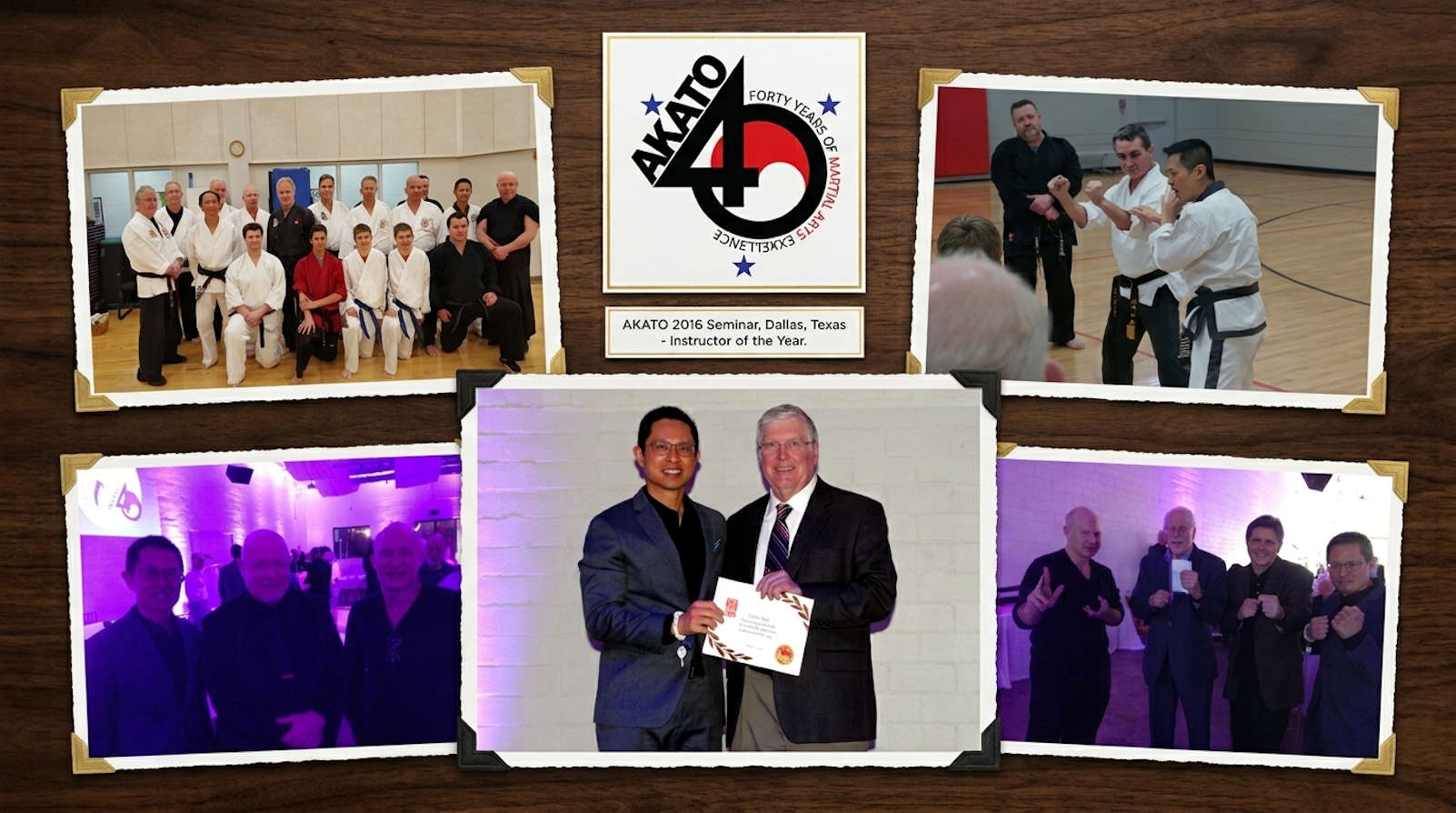
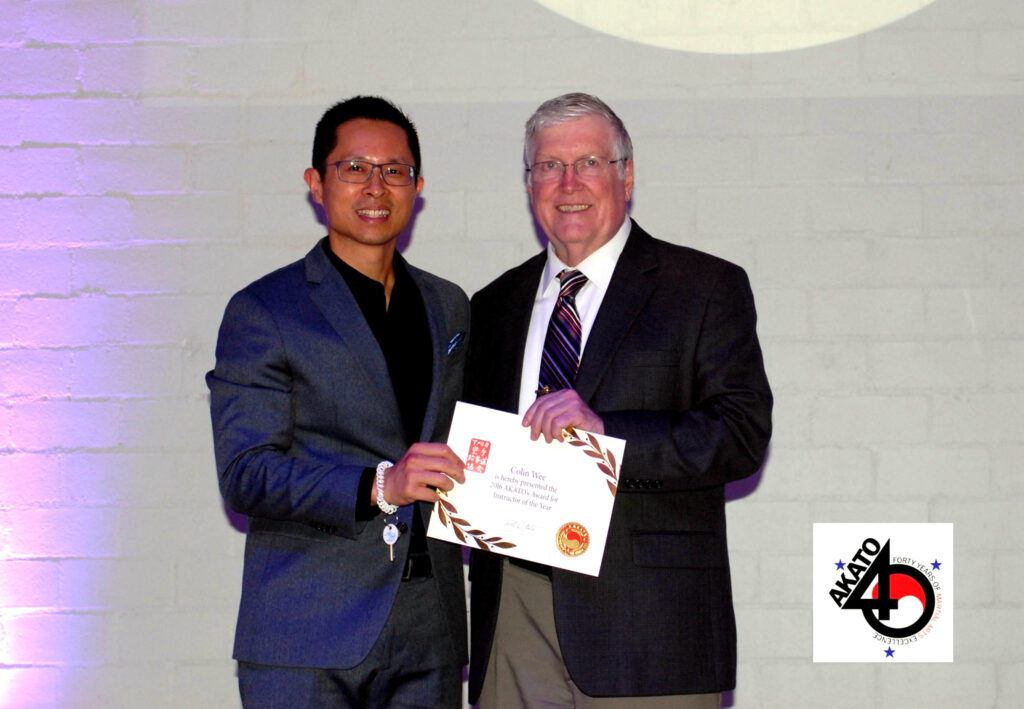
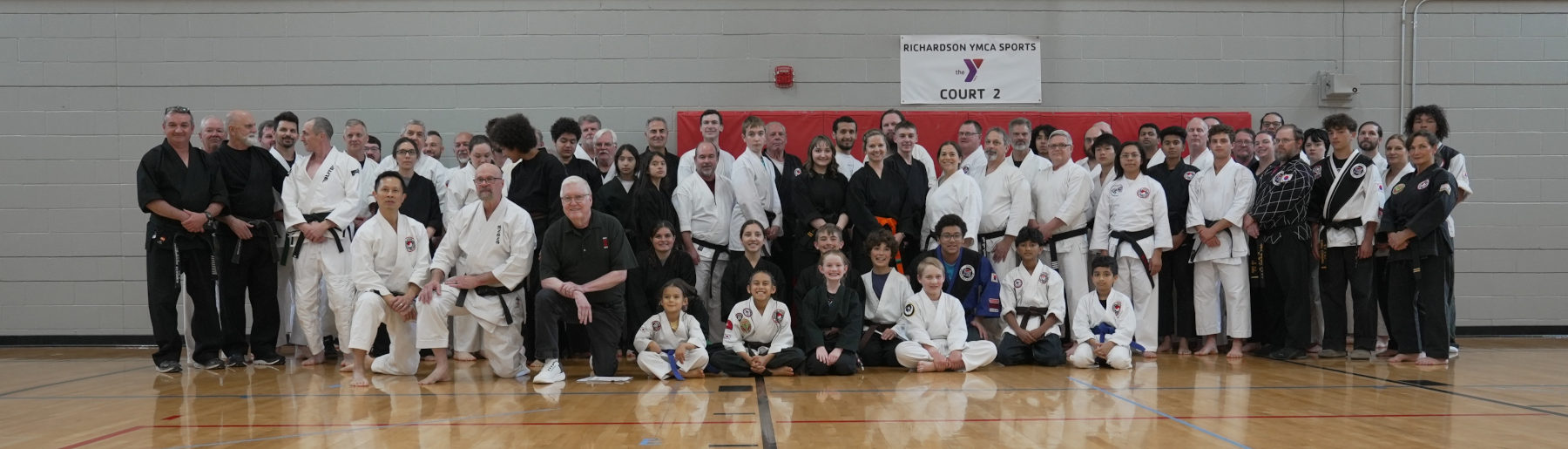
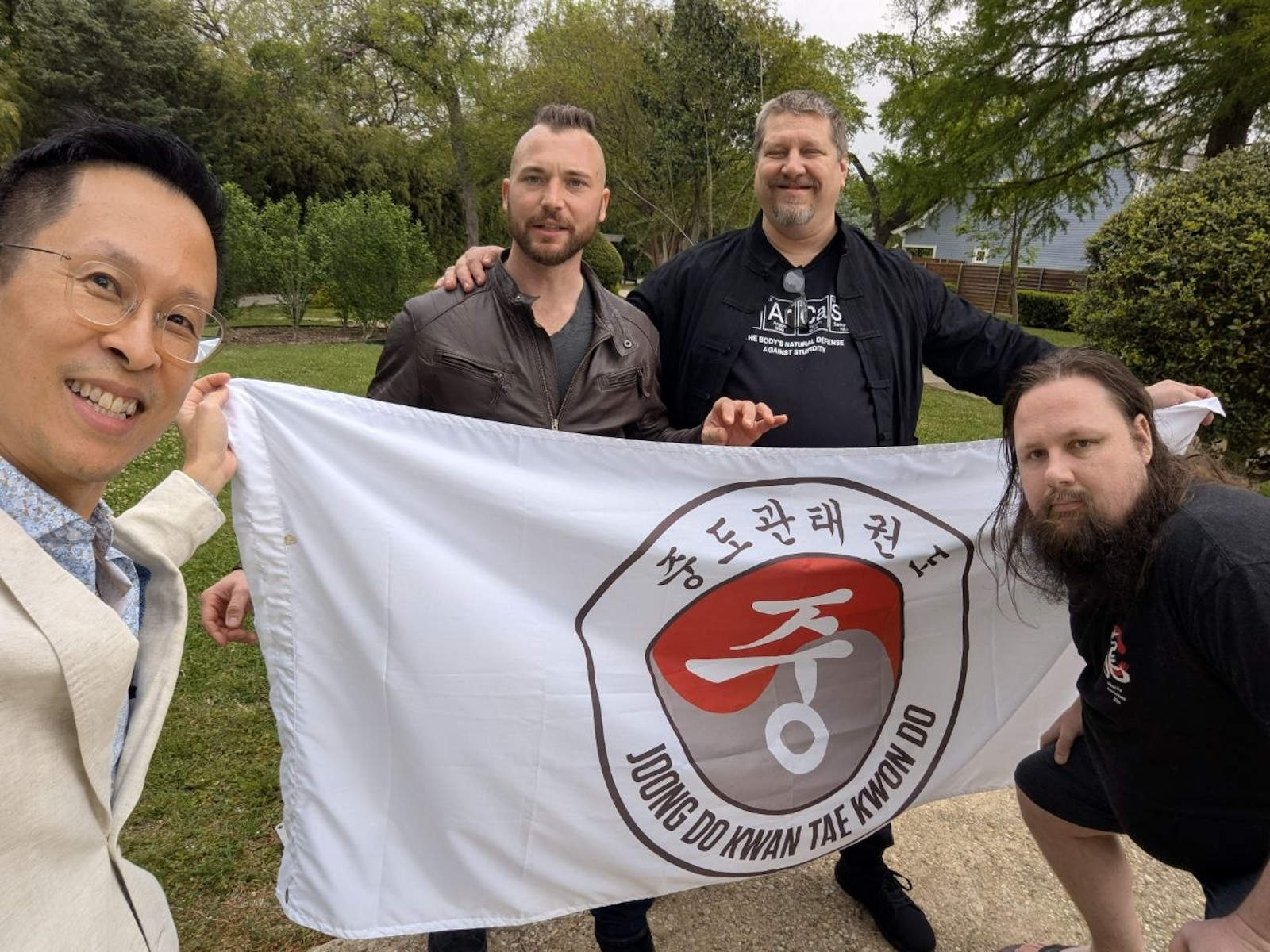
GM Keith Yates presents AKATO Instructor of the Year 2016 to Colin Wee
In 2015, I lost my dad and had to return to Singapore to take over his business. It was a difficult period, and I left my martial arts group in the care of my senior student while I focused on family responsibilities. Whenever I could participate in classes, I allowed myself to focus on specific material I wanted to explore deeply. I began filming those sessions, not knowing that this habit would pull me down a rabbit hole that would change the course of my martial arts career.
That was the beginning of my obsession with Bassai Dai. One kata, above all others. Those early videos became the foundation of my book Breaking Through: The Secrets of Bassai Dai. At the time, I didn’t realise I was building anything. I was just trying to understand the material more honestly.
In 2016, during the American Karate and Taekwondo Organization’s 40th Anniversary, I had the privilege of leading a seminar and sharing some of that early material. It was my first AKATO banquet, and after a long week I was absolutely shattered. As GM Keith Yates began announcing Instructor of the Year, I slowly realised he was describing someone who sounded very familiar. I was stunned when he called out my name. As someone who teaches a small, tight‑knit group, the honour meant more than I can express.
I remain deeply grateful to GM Yates for his kindness and encouragement, and for inviting me back to Dallas more often. Having both my instructors there, Bryan Robbins (RIP) and GM Mike Proctor, made the moment even more meaningful. And the friendships formed that weekend have stayed with me ever since.
A decade later, I returned to lead a seminar for AKATO’s 50th Anniversary, another huge honour, and a reminder of how blessed I’ve been to be welcomed into this family.
Bio: Colin Wee is a Singaporean author, martial‑arts instructor, and cultural historian whose four‑decade practice spans Asia, Australia, and the United States. Known for his analytical approach and deep tactical insight, Colin blends historical research with lived experience to illuminate the human stories behind martial traditions. He is the founder of Joong Do Kwan in Perth, Western Australia, and serves as Secretary of the Australasian Martial Arts Hall of Fame (see About the Author).
You can get a copy of Breaking Through: The Secrets of Bassai Dai Kata from Amazon or directly from the author at Ingram Sparks.
An international group of martial artists converged in Naha on 25 October 2025 to drink in the sights, practice martial arts, enjoy Ryuku Awamori, breathe in island life, and experience International Karate Day. The group, led by Colin Wee were intending to trace the steps taken by karate pioneers Itosu Anko and his mentor Matsumura Sokon. See Colin’s related article that foreshadows the tour How Jion Reshaped my Training and Led me to Anko Itosu.
It was amazing to have a group of high-level martial artists trusting me to plan this tour – taking a leap of faith purely based on my work on Okinawa and its history. While I planned the trip to have breadth and depth, to get this incredible commendation from Shihan Leonard was very gratifying! Thank you, Leonard! A 5-star review is always amazing, but more so impressive considering this trip was the first tour I’ve ever organised.
Have you planned a martial arts tour before? I would love to hear your experiences.
This clip was filmed during my official induction into the Australasian Martial Arts Hall of Fame, an event delayed from 2020 until borders were reopened. Western Australia had been fortunate during that period; while the world was locked in, life continued with relative freedom, and I had the luxury of continuing my preparations for the demonstration and seminar portion of the AMAHOF weekend.
Many who watched my demo later shared with me they were expecting aerial kicks and acrobatics, the spectacle people associate with Taekwondo. What they saw instead was something far more traditional, and far more reflective of the work my school had been immersed in for years.
What do you expect from a martial arts seminar?
Jion Bamboo Forest Colin Wee 2023
My usual explanation is I wanted to share traditional applications, or perhaps I was demonstrating whatever my school happened to be practising at the time. The truth was that I’d been deep in the rabbit hole for many years leading up to this point. In the late 2010s I pulled my school into an intense, single‑kata focus. When COVID shut the world down, and when we realised how much insight that deep dive had produced, we finally gave in to the idea that had been circling around for years: this needs to become a book.
Motivated by our phenomenal progress, I switched tracks and plunged into the next kata Jion. Supporting me was the last remaining black belt at JDK. While I could say COVID decimated my school, the reality was that training one kata day‑in, day‑out was not for everyone.
How do you ‘find’ bunkai?
Our process is demanding. When we explore a kata or a combative system, we deconstruct every facet of it. We break it apart, test it against a non‑compliant opponent, rebuild it, and repeat. By the time this video was filmed, we had spent nearly three intense years taking Jion on a wild ride. And then we reached an event horizon: when we took stock of Jion, we were shocked to find at a high level it was nothing like Bassai. For those who don’t already know, Bassai was the kata that formed the backbone of my first book, Breaking Through: The Secrets of Bassai Dai Kata.
The Jion seminar at AMAHOF 2022 was when we were standing at the cusp of embarking on an amazing journey back into the beginnings of hard style martial arts.
How do you start writing a Martial Arts Book?
That realisation forced us into frenzied research. Pulling on Jion’s threads was what led to unexpected discoveries about the pioneers of our martial art. One insight led to another, and before long an entire historical tapestry fell into view. It was then I knew I owed it to the world to begin work on Anko: The Lost Scrolls of Ryukyu.
I was apprehensive not quite believing I had the chops to adequately deliver the story. It was an epic beginning with the Japanese subjugation of Ryukyu in the 19th century, and culminating with beleaguered ex-bureaucrats attempting to preserve their culture by developing karate as a training program for the century ahead.
Acquiring Soft Power in Martial Arts
If you watch the demonstration, you can see my search for precursor know-how had influenced my own practice. My abilities were clearly shifting, though it wasn’t a deliberate move on my part to emulate the Ryukyuans. My research had led me to postulate their goals, and that required the retrofit of hard‑style and soft‑style skills back into kata and application work.
From 0:02–0:08, you can see me working through an application to bypass the tangle of arms – while my partner was deliberately offering active resistance. I remember noticing the difficulty as I narrated; eventually I had to trust my senses to take over, read his movement, bypass the resistance and displace his structure for the takedown.
What this is is me dealing directly with my opponent. I’m not “demonstrating” Jion nor trying to prove how closely my skills resemble its sequences. Yes, I’ve worked with Jion’s technical sequences. I’ve also varied them endlessly. And when the adversary opposes them, I naturally circumvent and bypass the obstruction instinctively. The read of the situation and response to the unscripted, dynamic attack come easily – because that is what the training helps you do. Jion informs the initiative, it does not limit it.
Likewise, I could have written another non-fiction book laying out a sequence of historical facts. I could have stuck rigidly to historical cannon, the way many insist application bunkai must resemble the kata. But would that do justice to the story though? Or is it more meaningful to feel their journey, like the way I’m now pushing past hard-style training into soft-style tactics.
That, I believe, is the truth martial artists actually want.
Bio: Colin Wee is a Singaporean author, martial‑arts instructor, and cultural historian whose four‑decade practice spans Asia, Australia, and the United States. Known for his analytical approach and deep tactical insight, Colin blends historical research with lived experience to illuminate the human stories behind martial traditions. He is the founder of Joong Do Kwan in Perth, Western Australia, and serves as Secretary of the Australasian Martial Arts Hall of Fame (see About the Author).
Waneroo, Perth, 2 Dec 2024. Kyoshi Peter Hunt hosted a session to explore concepts in the book Breaking Through: The Secrets of Bassai Dai Kata. In that seminar, we looked at the underlying thought process which led to the publication which we referred to as “The JDK Method.”
Guest Contributor Shihan Leonard Montagnana participated in the Wanneroo event, and we’re excited to share his report on AJJJCBFI’s Academy News Summer 2025 Edition #95 below.
The JDK Method is a distillation of two decades of work to answer the question “What is Bunkai?” It firstly considers the vagaries of preemption. Under duress, practitioners are hard pressed to read the combative landscape and accurately predict what is happening.
The other questions that may be asked are “What attack is coming my way?” or “Is it a left or right handed strike?” For this, we advocate for techniques to be used as multitools. Ideally, your one technique should apply to a left side attack, as does to a right side attack. Secondly, we assume failure of technique. The opponent is there to oppose you. Thus, it is to your advantage to prepare for that opposition. If resistance could shut down your tactic at any point, train for workarounds, and draw freely from your library of skills.
If you bunkai to you is simply one solution to one problem, you may need to revisit your training pedagogy. What is the end goal your training is leading you towards? Is it choreography? Or is it to acquire fight IQ?
The Breaking Through book eventually leads to the work on my historical fiction manuscript. For those practitioners who think a novel is beneath them, that operative word ‘fiction’ is there only so I may pick apart the facts from the truths. Stick with me, it’s going to be a compelling ride!
📖 Flip through Breaking Through here and then get your free Book Club Kit
Bio: Colin Wee is a Singaporean author, martial‑arts instructor, and cultural historian whose four‑decade practice spans Asia, Australia, and the United States. Known for his analytical approach and deep tactical insight, Colin blends historical research with lived experience to illuminate the human stories behind martial traditions. He is the founder of Joong Do Kwan in Perth, Western Australia, and serves as Secretary of the Australasian Martial Arts Hall of Fame (see About the Author).
During AKATO’s 50th Anniversary weekend in Dallas (March 2026), I taught a session that allowed me to share the research shaping Anko: The Lost Scrolls of Ryukyu. Much of my work over the past few years has involved reconstructing how Ryukyuan retainers combined hard‑style initiative with soft‑style internal mechanics, a blend that’s rarely seen in modern training.
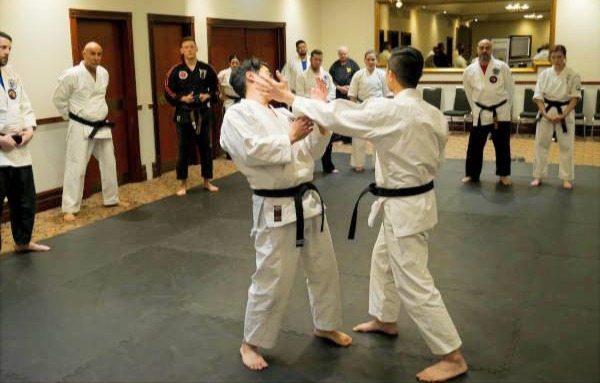
The demonstration opened with an application drawn from Nam Seo Hyung: closing distance, prompting reaction, and using circular movement to create openings along the centreline. From there, the sequence branched into two close‑quarter variations inspired by Jion, each exploring a different way to manage the opponent’s structure: either through limb control or through neck manipulation, and balance disruption.
What is the difference between hard-style v soft-style martial arts?
For many practitioners in the room, this was unfamiliar territory. Hard‑style systems often emphasise direct power, while soft‑style methods rely on timing, whole‑body coordination, and subtle changes in pressure. Bringing these ideas together and showing how Ryukyuan retainers may have used them in real conflict, created some dramatic moments. With very little visible movement, my training partner’s balance was broken and his momentum carried him across the floor. In another variation, a circular pulse around the neck opened the way for a controlled takedown and a simulated weapons check.
What I hoped to share wasn’t a highlight reel of ‘lethal’ techniques, but a window into the research process: how historical context, body mechanics, and cross‑style exploration can reshape our understanding of a fighting system. Ryukyu’s retainers were small in stature, but they relied on efficiency, teamwork, and a fusion of ideas to maintain advantage in asymmetrical situations. That blend continues to fascinate me, and it’s a core part of the world behind Anko: The Lost Scrolls of Ryukyu.
If you’d like to see a portion of the Dallas session, the video is available at:
Bio: Colin Wee is a Singaporean author, martial‑arts instructor, and cultural historian whose four‑decade practice spans Asia, Australia, and the United States. Known for his analytical approach and deep tactical insight, Colin blends historical research with lived experience to illuminate the human stories behind martial traditions. He is the founder of Joong Do Kwan in Perth, Western Australia, and serves as Secretary of the Australasian Martial Arts Hall of Fame (see About the Author).
Perth, Western Australia, May 2025: Editor David Moore and myself are videoed talking about our project The Lost Scrolls of Ryukyu. This project is inspired by true events which start with the annexation of Ryukyu in the 19th century, and leads us to then track the lives of a few martial art masters affected by the cultural subjugation.
If you’ve read Breaking Through, you’d probably see the throughline. The Lost Scrolls is me adamant once more to follow the breadcrumbs back in time. Breaking Through had done its job looking at what was bequethed us, but it stopped way short of looking at the lived experiences of the architects of our martial arts.
As I gained an appreciation for the enormity of this story, I never felt more compelled to finish what my first book had started.
I’d love to hear what you think. Would you expect a historical fiction novel to teach you anything about martial arts? Would you be interested to read about the pioneers of your martial arts set in a fictionalized story? If you’re on Goodreads, drop a question there.
Bio: Colin Wee is a Singaporean author, martial‑arts instructor, and cultural historian whose four‑decade practice spans Asia, Australia, and the United States. Known for his analytical approach and deep tactical insight, Colin blends historical research with lived experience to illuminate the human stories behind martial traditions. He is the founder of Joong Do Kwan in Perth, Western Australia, and serves as Secretary of the Australasian Martial Arts Hall of Fame (see About the Author).
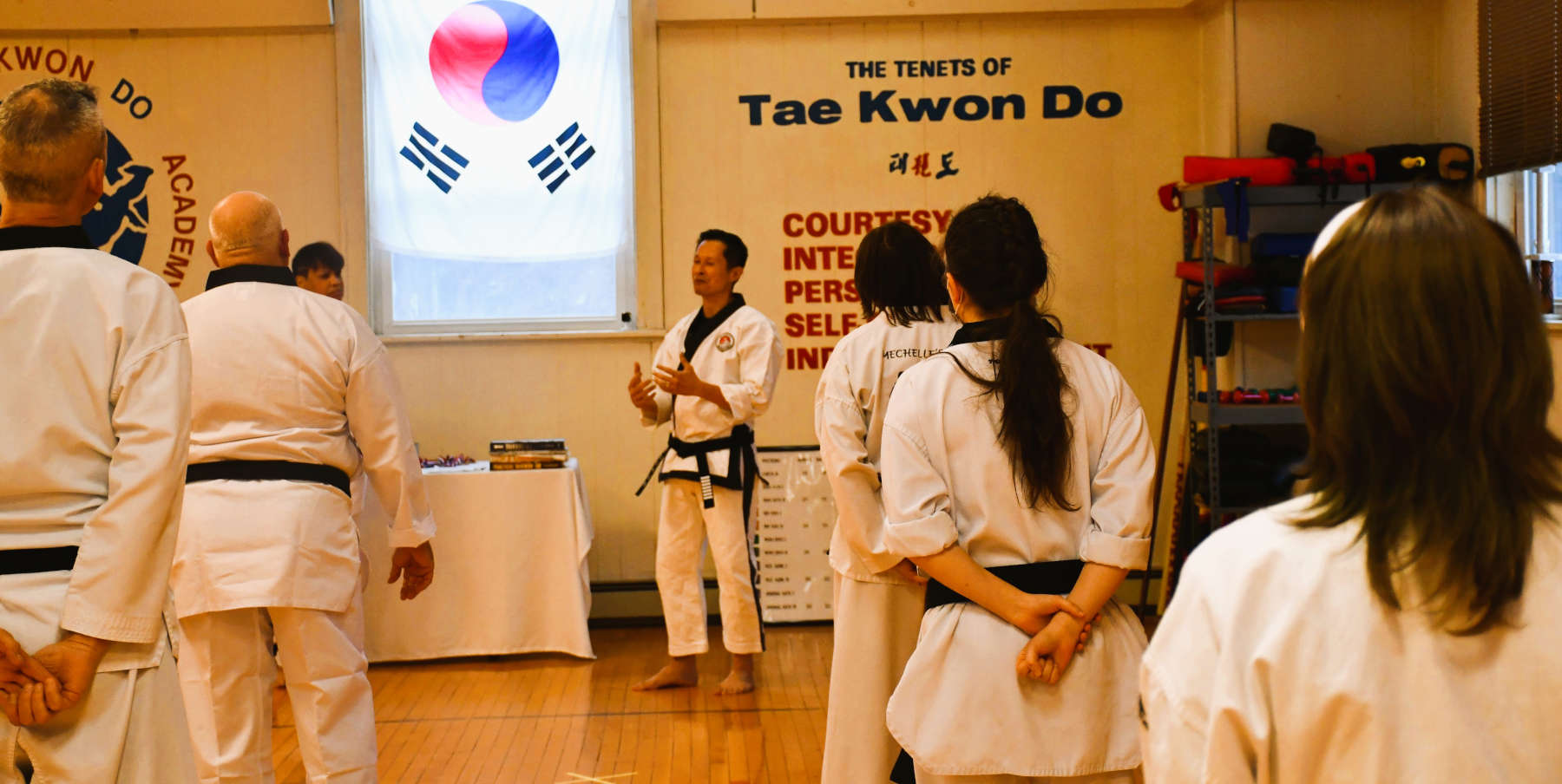
A trip to JDK USA Schenectady, New York, for a martial arts seminar in January 2024 pushed me outside my comfort zone. It followed a successful seminar and book launch in Dallas the previous year.
New York felt daunting. It was uncharted territory, a stark contrast to the familiarity of Dallas. Yet, it presented an excellent opportunity to strengthen my working relationship with host Master Will Just
Will had connected with me five years prior, and was my demonstration partner in Dallas. He was captivated by training methodology, and the emphasis on extracting practical applications from traditional forms.
When my wife’s work led to a short stint in New York, I reached out and encouraged Will to organize a seminar. The timing wasn’t ideal: as the holidays and harsh winter would decrease attendance and ticket sales. Undeterred by the challenges, Will, fueled by his experience in Dallas, mobilized his network, visited schools he wasn’t connected with, and promoted the event feverishly.
Getting to my martial arts seminar
Traveling from Australia was an adventure itself, and after a week trampling around Manhattan with my wife, I took the three hour train ride up to Schenectady. It was good to see two familiar faces : Will Just, and long time JDK Associate Jeff Palm. Taekwondo Times Editor Jack Berry, whom I had connected with just the week earlier had also traveled up from Manhattan with me.
The seminar focused on unlocking the hidden potential of traditional forms and exploring their practical applications. We emphasized the importance of anticipation, sensitivity to the opponent, and circumventing the opposition. While the material took participants to the edge of their comfort zone, it was good seeing enthusiastic smiles, and the willingness to give things a go.
A highlight was witnessing a visiting Grandmaster seamlessly blend her long-time police experience with the seminar material, demonstrating the inter-relatedness of tactical skill.
Expanding my martial arts network
This journey to Schenectady was far from being just another martial arts seminar. It reaffirmed the value of venturing outside comfort zones, embracing the unexpected, and fostering meaningful connections. Directly inspired by the visit, Will Just moved to establish a new branch of JDK to develop his own martial arts training group.
This is a reminder that growth often lies beyond familiar territory, and that stepping outside our comfort zones can open doors to new possibilities and enrich our lives in profound ways.
Bio: Colin Wee is a Singaporean author, martial‑arts instructor, and cultural historian whose four‑decade practice spans Asia, Australia, and the United States. Known for his analytical approach and deep tactical insight, Colin blends historical research with lived experience to illuminate the human stories behind martial traditions. He is the founder of Joong Do Kwan in Perth, Western Australia, and serves as Secretary of the Australasian Martial Arts Hall of Fame (see About the Author).
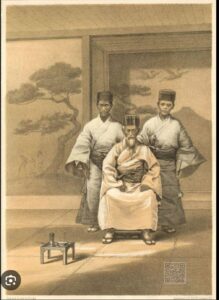
Lithograph taken by Commodore Matthew Perry in 1853 of two Ryukyuan Attendants and a stand in for the Regent
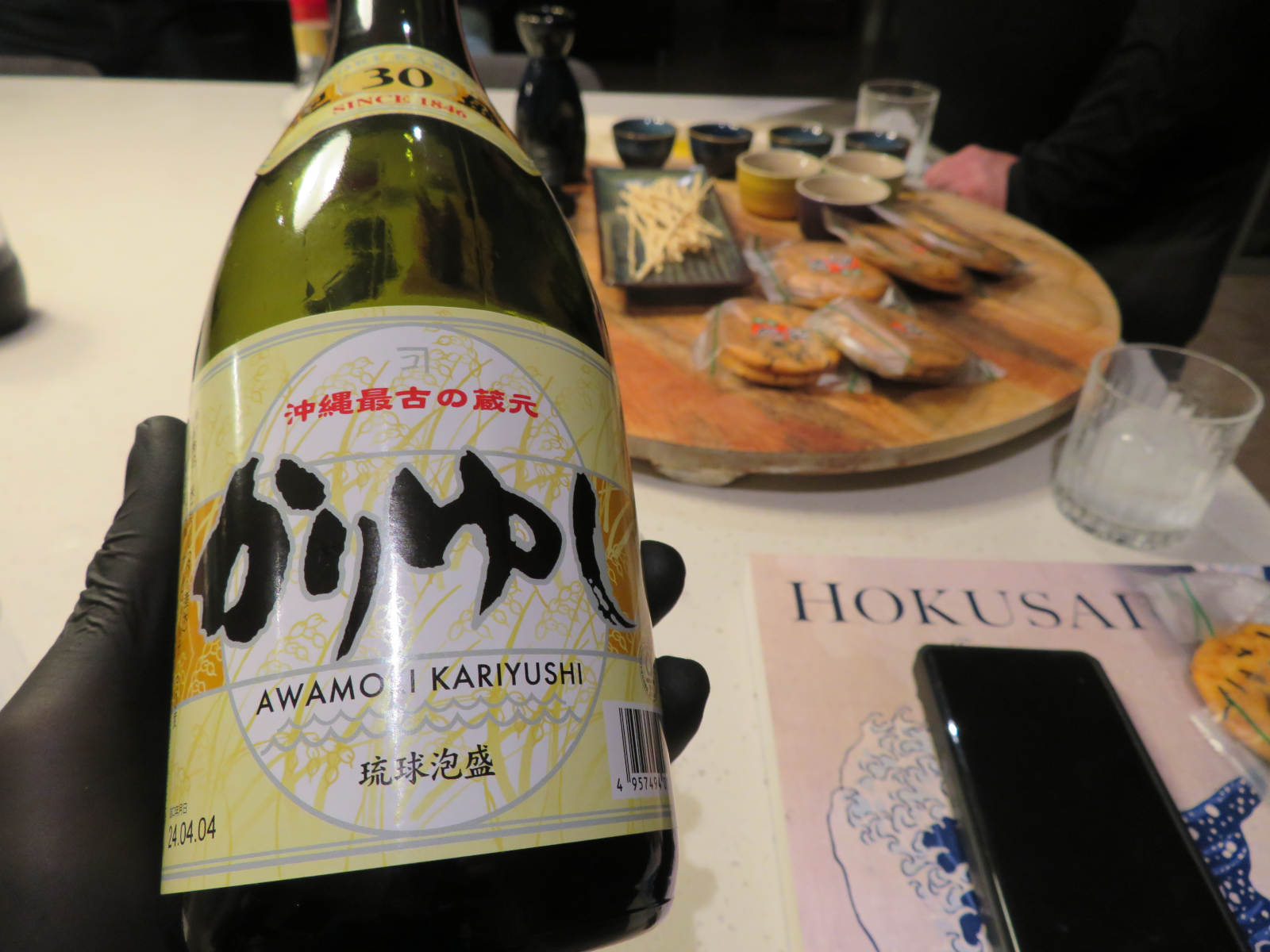
新里酒造 Shinzato Shuzo, established in 1846, is the oldest existing awamori dstillery in Okinawa, known for traditional distilling techniques and the quality of its products.
While researching the story of the pioneers of karate, I happened on a claim by Shinzato Shuzo that when Commodore Matthew Perry and his black ships sailed up to Ryūkyū in 1853, there were only three villages on the island that were sanctioned as distillers by the government.
I had long known Perry had “landed two cannons and two companies of U.S. Marines … Along with 50 naval officers and two brass bands” at Naha port, and then marched them over two hours all the way up to Shuri Castle (Clayton, Shotokan’s Secret p77).
Thanks to Dr Clayton I also know a terse stare down occurred, though the Commodore was amendable to the Ryukuan’s reluctant hospitality, happily imbibing the proferred rice wine, and possibly enjoying sweet chinsuko cookies the royal kitchen was famed for. While there, the Commodore decided to stop and capture the moment, taking a lithograph (as seen above). His happy snap includes historical Tode masters, and a stand-in for the Ryukyuan King. Lo and behold, the image also shows a small table with the receptacles likely used to serve the royal awamori.
Discovering there was the chance that the awamori Perry may have enjoyed could have come from the Shinzato Shuzo distillery, I immediately ordered a bottle of their かりゆし Kariyushi Awamori for tasting. As it transpires, the protagonist and his friends as featured in my upcoming historical fiction novel reached for this libation often and in copious amounts.
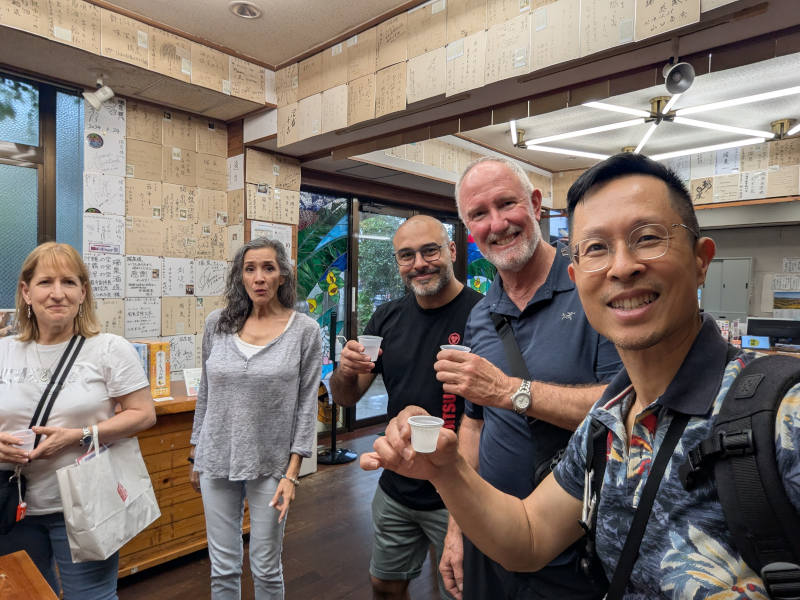
Zuisen Awamori tasting with some of the participants of the international Martial Arts Cultural Exchange Group, led by Colin Wee. October 2025. L->R Elaine Ogden, Vivica Lamarche, Leonard Montagnana, Peter James, and Colin Wee. Note: Zuisen Distillery was founded in 1887 – just after annexation happened.
What happened during the Ryukyu Annexation?
The book is not comic relief about historic martial artists going on an epic bender. It recreates the incredible challenges which happen after the arrival of the Commodore, where a sequence of events lead to Ryukyu being subjugated by Japan. What ensued then was a real threat to their culture from Japanification, and options to build solidary and protect their identity were extremely limited.
While their life situation might seem foreign and so distant, the more I plunged into my research, the more I became acquainted with them as people. Unexpectedly, a bond developed across time.
This blog post is a Hail Mary move. I’m using it to reach out to Shinzato Shuzo or in fact any organisation that identifies with the Ryukuans desperate situation and their hopes for a better future. There is an opportunity to solidify a presence in this project, to help the publication of their life’s story, and give voice to an era that is too much at risk of simply fading away.
We need to help give a voice back to Ryukyu
Together, with your support, we can honour the lives of those Ryukyuan martial art pioneers, and remind everyone of what they did to help uplift all indivudals who need guidance, training, and were overwhelmed by life and modernization. Also together we can get more people to enjoy awamori.
On the palate, Shinzato Shuzo is fruity and has refreshing drinkability. With aging, sweetness and umami are enhanced, eventually taking on a smooth caramel flavor.
Bio: Colin Wee is a Singaporean author, martial‑arts instructor, and cultural historian whose four‑decade practice spans Asia, Australia, and the United States. Known for his analytical approach and deep tactical insight, Colin blends historical research with lived experience to illuminate the human stories behind martial traditions. He is the founder of Joong Do Kwan in Perth, Western Australia, and serves as Secretary of the Australasian Martial Arts Hall of Fame (see About the Author).
In October 2025, I travelled to Okinawa as part of my ongoing research for a historical fiction manuscript that is set in 19th‑century Ryukyu. This new book project follows a group of bureaucrats navigating the political and cultural pressures of the Japanese annexation, and I couldn’t write about that world responsibly without spending time there myself. Even though the work is historical fiction, I wanted to avoid grossly misrepresenting the people, the culture, or the context I was drawing from.
During the trip, I had the opportunity to teach at a Master Instructor Seminar held at Midorigaoka Park in Naha coordinated with Okinawa Karate Day. My session focused on Jion kata bunkai, using applications and tactical logic that tie into themes from the manuscript. The work blended structural mechanics, hard‑ and soft‑style concepts, and principle‑based interpretation. It was a good chance to share ideas in front of expert practitioners who enjoy the roots of these traditions as much as I do.
Author Colin Wee Martial Arts Cultural Exchange Seminar at Midorigaoka Park
Finding where Anko Itosu and Matsumura Sokon are buried
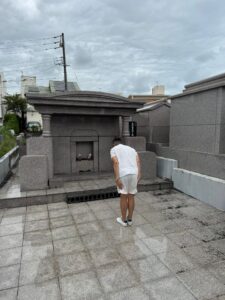
One of the moments that has stayed with me wasn’t from the seminar itself, but from a quiet visit I made with our small group to the graves of Matsumura Sōkon and Itosu Ankō (Visit Matsumura Sokon’s grave26°13’28.7″N 127°42’20.4″E Google Map: 6PF4+V7 Naha and Itosu Anko’s grave – 84m SE of Matsumura’s grave, at Makabi. Directions: take monorail to ‘13 Naha City Hospital’, walk 700m Southwest of Station. Address: 3-10 Makabi, Naha City, Okinawa 902-0068, Japan.)
Standing there and speaking about their lives and contributions felt significant in a way that’s hard to articulate. It wasn’t about romanticising the past; it was simply to acknowledge the people whose work shaped so much of what we practise today. That experience grounded the rest of the trip for me.
Being in Okinawa helped me understand the environment, rhythms, and cultural texture I’m trying to represent in the manuscript. It also reminded me that martial arts is always connected to real people, real places, and real histories. That’s something I want to carry forward in both my writing and my teaching.
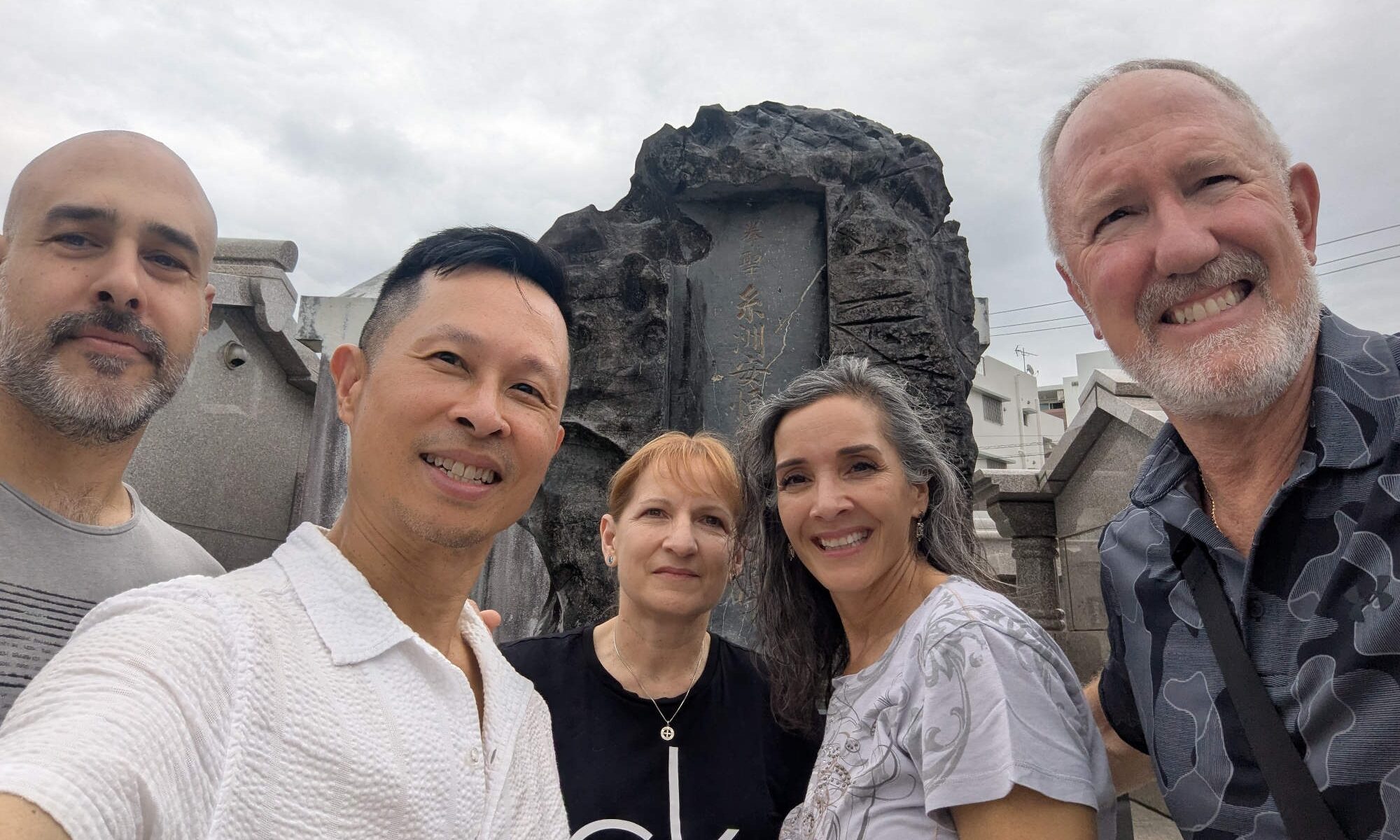
Author Colin Wee visiting with his protagonist Anko Itosu, Makabi Cemetary, Okinawa Oct 2025
As I prepare for the American Karate and Taekwondo Organization’s 50th anniversary event next March 2026, I’m looking at how to integrate insights from this research, the Jion applications I’ve been finessing, and material that aligns with AKATO’s lineage. My aim is the same as it has always been: to contribute in a way that allows us to understand and celebrate the traditions we’ve inherited.
I’d love to hear what you think. If you’re on Goodreads, drop a question there. Or if you’re an Okinawan business or organisation that identifies with my work 琉球武術支援, I would love to connect with you. What would you like to see in a story that supports the lived experiences of martial art pioneers? What would you expect of these historical characters?
Bio: Colin Wee is a Singaporean author, martial‑arts instructor, and cultural historian whose four‑decade practice spans Asia, Australia, and the United States. Known for his analytical approach and deep tactical insight, Colin blends historical research with lived experience to illuminate the human stories behind martial traditions. He is the founder of Joong Do Kwan in Perth, Western Australia, and serves as Secretary of the Australasian Martial Arts Hall of Fame (see About the Author).