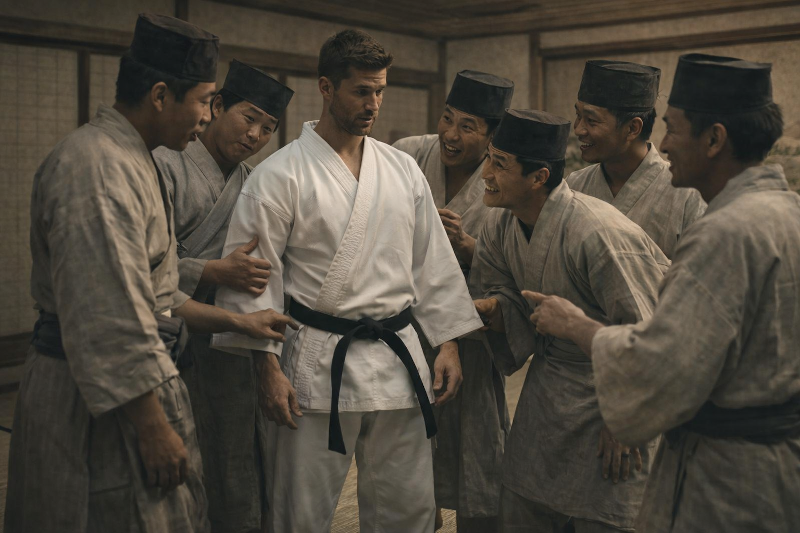

While working on the Patreon articles supplementing Application 3 in Breaking Through: The Secrets of Bassai Dai Kata, the first article A JDK Perspective on Kata, Human Variability, and the Insight of the Pioneers drew parallels between our insight into kata analysis, the human condition in combative exchanges, and the life circumstances of martial art pioneers.
The article attributed our increasing insight to years of watching how students assimilated our training and how their decision‑making preferences emerged during exchanges. With that discussion in mind, I went searching for photos that might represent that period of time, photos that would capture the moment when everything changed.
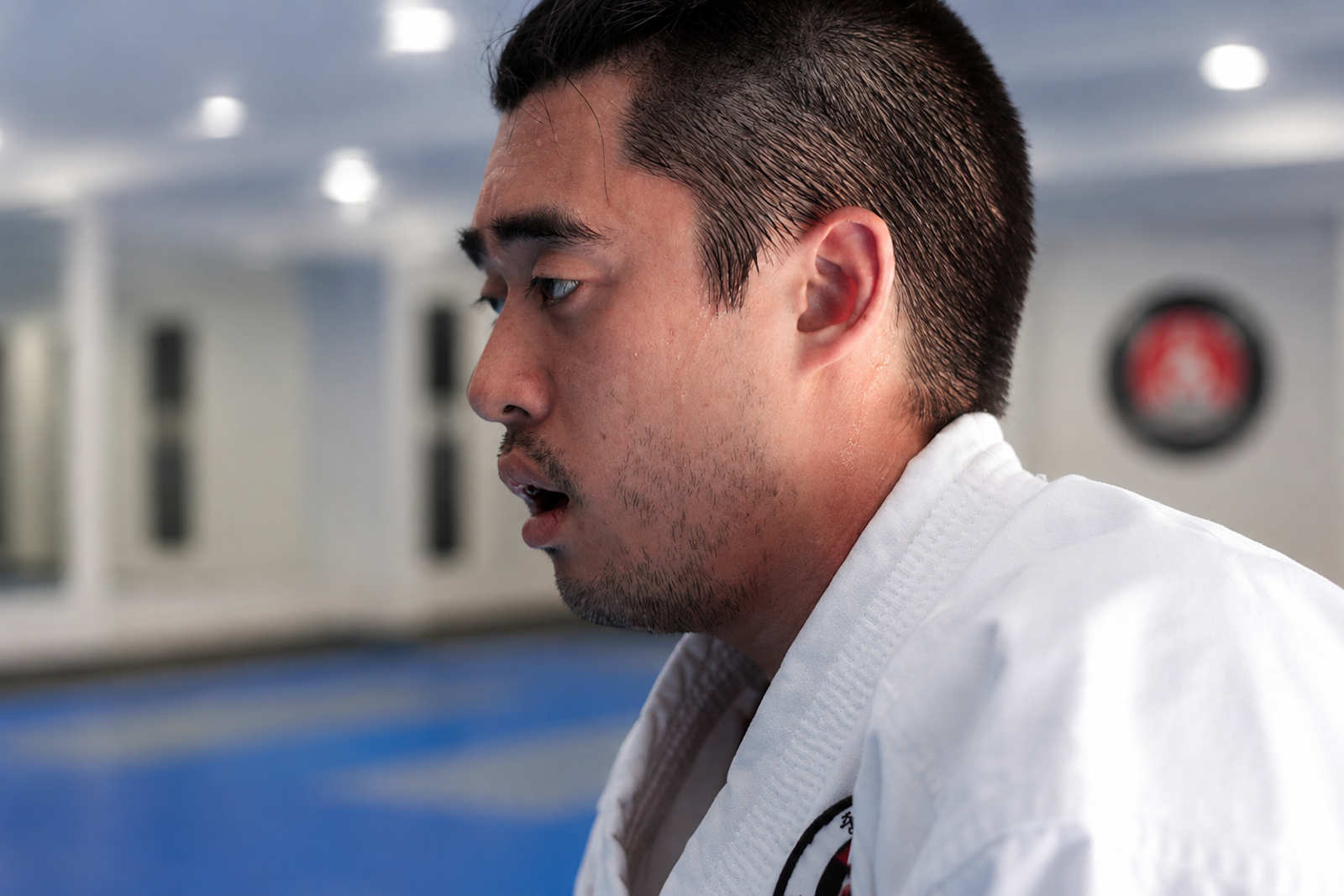
The photos I stopped at were of JDK Black Belt Joshua Lay, then a 4th kyu student during his grading in 2014.

They were taken at a turning point for Josh, and they mirrored an event horizon within JDK that eventually led to the JDK Method. But more importantly, they marked a turning point for me as an instructor.
Up until then, Josh struggled with the syllabus. Everything we presented seemed not to match his learning style. He attempted techniques and applications, only to completely forget them the lesson after. Yet a switch occurred for him at 4th kyu, when we introduced a type of randori we call Superlight, a slow, collaborative, and most importantly, free‑flowing exchange in an ultra-safe environment.

Something clicked. When he realised we weren’t trying to force him to remember specific moves, but to understand concepts, things happened all at once: the read of distance, the control of the opponent, and the essence of a tactic just came together. From there, it became easier for him to feel what was happening and then make sense of the process flow we needed to see.
Up until this point, JDK had gravitated to using patterns as a syllabus for about ten years. We had not yet embarked on my book project, which would become a five-year adventure. But the adoption of Superlight closed the loop for us. Deconstructing kata, varying the technique, and applying tactics in two-person drills were our fledgling efforts in celebrating traditional form. Superlight was what allowed us to test our assumptions in a dynamic situation. The feedback it provided allowed us to gauge the worth of our ideas. Distancing. Angles. How to stitch tactical elements together. Everything.
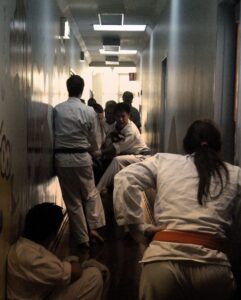
Two years before these photos, in what I thought was a stroke of genius, I set up a challenge for my then senior student Niaal Holder’s black belt grading. At one point during the grading, I had all our students stand in a corridor holding body shields and kick pads, and made him fight his way through the gauntlet while they actively tried to stop him.
Without thinking too hard about it, I felt it was only right to introduce a challenge for Josh that would match or exceed Niaal’s grading, you know, just to be fair. An email was sent to a few friends who headed up different martial arts schools, asking them to send a few volunteers to help.
Fortunately, my friends trusted me and had enough faith in what I wanted to achieve. On the day, I was absolutely delighted to have seven strapping black belts from Okinawan Karate, Chinese Martial Arts, Muay Thai, and Taekwondo backgrounds come to spar Josh.
Josh was still required to tick off his grading components, so we split the sparring into three parts, allowing everyone to see how he was faring while being brought to the edge of physical exhaustion. We also factored in time so our guests could spar each other too, ensuring they’d leave with good memories from the session.
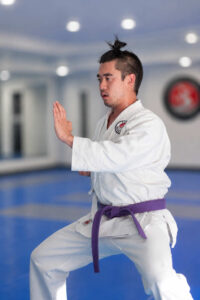
With my instructor’s hat on now, I’ll just come out and say it: there’s a time and a place to push yourself. Something like this doesn’t necessarily need to be in a grading. I conceived the initial “Gauntlet of Pain” because Niaal had been plagued by self-doubt, and believed a black belt test had to be a brutal trial by fire. To have such a test for a 4th kyu purple belt was not necessary.
The entertainment was, without a doubt, next level. They each knew what we were trying to do, were aware that safety was a priority, and they all allowed themselves to play. By ‘play’ I mean they engaged in a competitive yet collaborative manner, and that allowed everyone to show off the best of their training. I was blessed to have spectated that day.
And looking back now, these photos do more than capture a grading. They capture the moment when I was happy to let go of some of JDK’s early hard style assumptions. The moment I realised that pushing students to the max: testing their endurance, their pain tolerance, their ability to “survive” wasn’t the acid test of how good martial arts were really taught.

The pioneers didn’t build their systems around impossible hardship. They built them around sensitivity. Around strategy. Around safety. Around understanding how humans behave under pressure.
These photos show the moment I let go of my own hubris and finally understood that.
And those themes of human variability, the emergence of natural movement, and the advocacy of sensitivity and strategy are explored across the three articles from my Patreon’s coverage of Application Three.
Breaking Through Application Two, Full Article Series:
- Why Bassai Repeats the Middle Block Three Times, and What That Means for Application 2
- Patreon Premium: When the Middle Block Stops Being a Block
- Evolving the Middle Block from Hard Style System into a Soft Style Artform
Breaking Through Application Three, Full Article Series:
- A JDK Perspective on Kata, Human Variability, and the Insight of the Pioneers
- Patreon Premium: Working the Pocket, Disappearing from View, and Rising Into the Target
- 守破離 Shuhari: The Stages of Mastery
📸 Sandy Lim
Bio: Colin Wee is a Singaporean author, martial‑arts instructor, and cultural historian whose four‑decade practice spans Asia, Australia, and the United States. Known for his analytical approach and deep tactical insight, Colin blends historical research with lived experience to illuminate the human stories behind martial traditions. He is the founder of Joong Do Kwan in Perth, Western Australia, and serves as Secretary of the Australasian Martial Arts Hall of Fame (see About the Author).
You can get a copy of Breaking Through: The Secrets of Bassai Dai Kata from Amazon or directly from the author at Ingram Sparks.
© 2023 Colin Wee. Images reproduced from Breaking Through: The Secrets of Bassai Dai Kata. All rights reserved. No part of these images may be reproduced or distributed without permission.