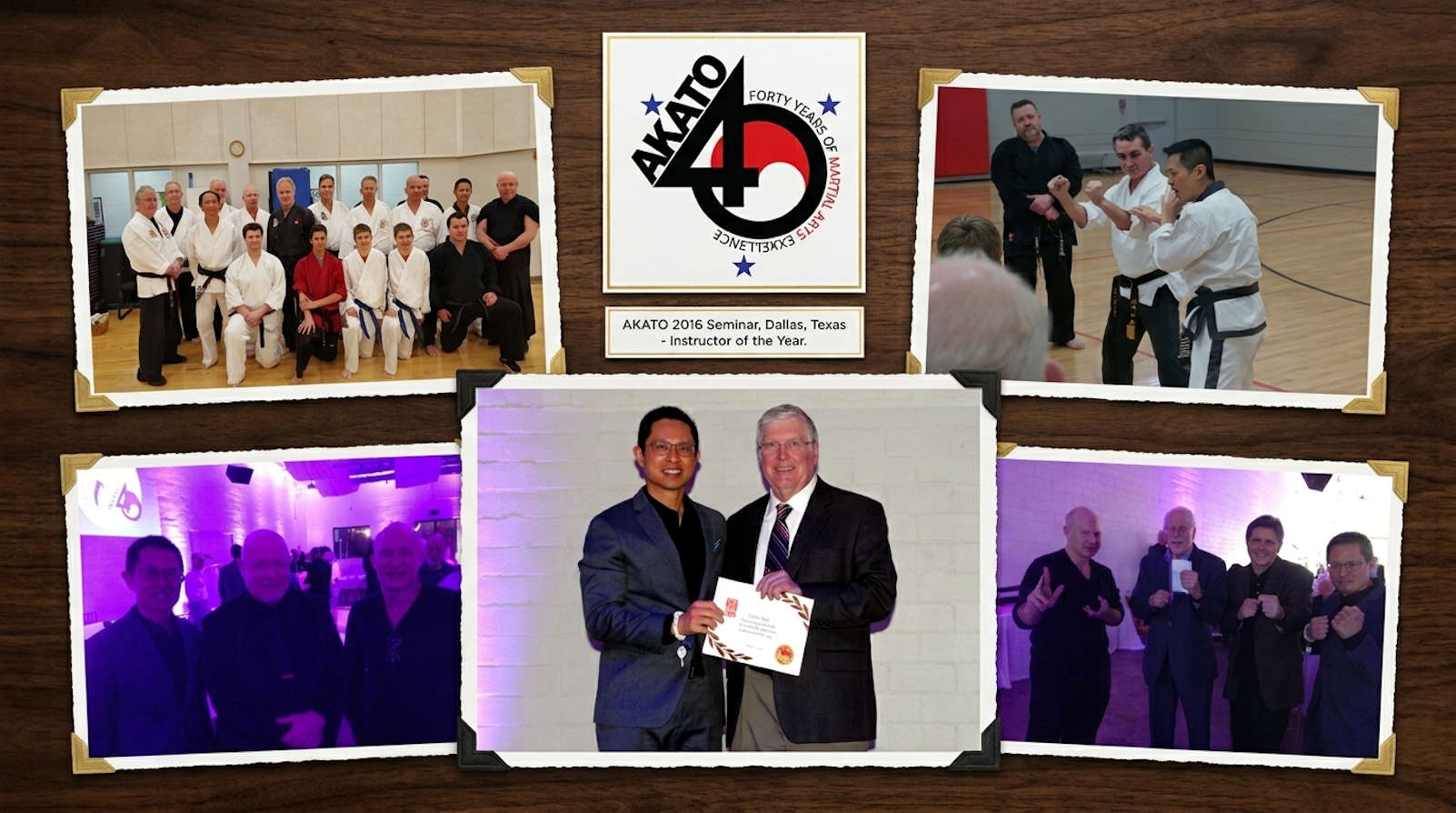
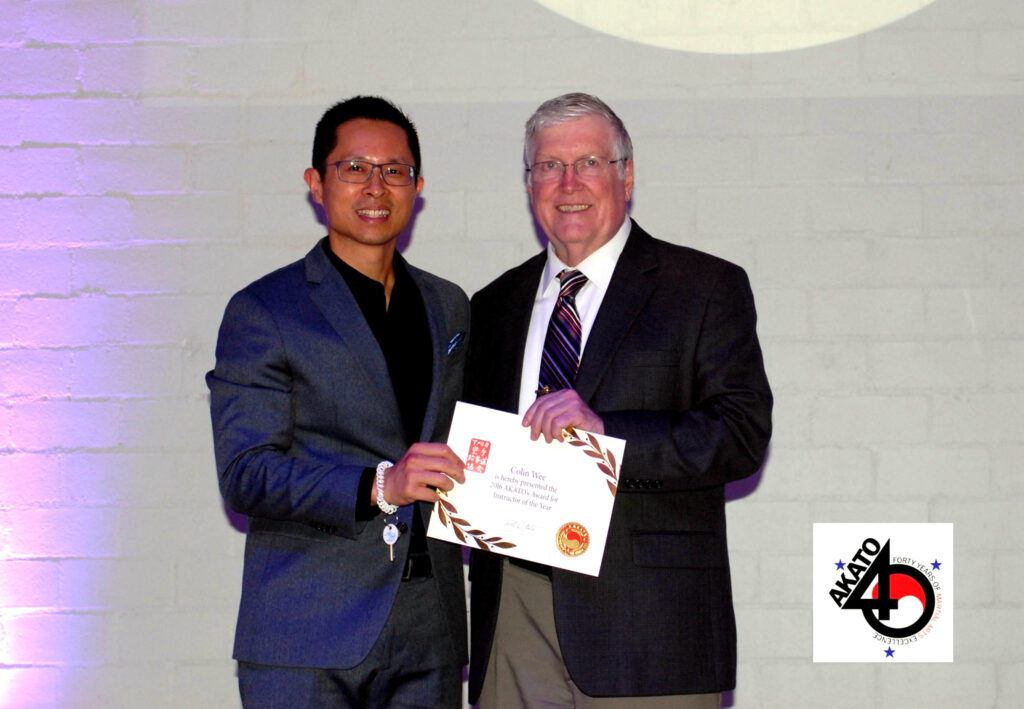
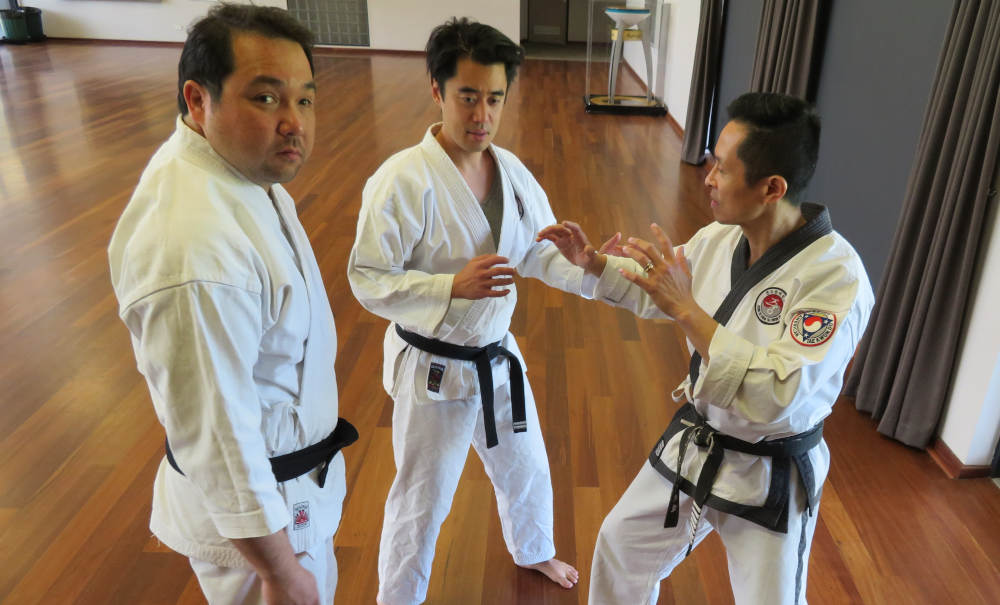
GM Keith Yates presents AKATO Instructor of the Year 2016 to Colin Wee
In 2015, I lost my dad and had to return to Singapore to take over his business. It was a difficult period, and I left my martial arts group in the care of my senior student while I focused on family responsibilities. Whenever I could participate in classes, I allowed myself to focus on specific material I wanted to explore deeply. I began filming those sessions, not knowing that this habit would pull me down a rabbit hole that would change the course of my martial arts career.
That was the beginning of my obsession with Bassai Dai. One kata, above all others. Those early videos became the foundation of my book Breaking Through: The Secrets of Bassai Dai. At the time, I didn’t realise I was building anything. I was just trying to understand the material more honestly.
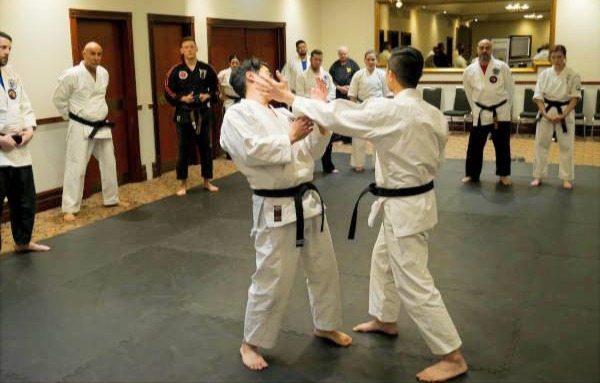
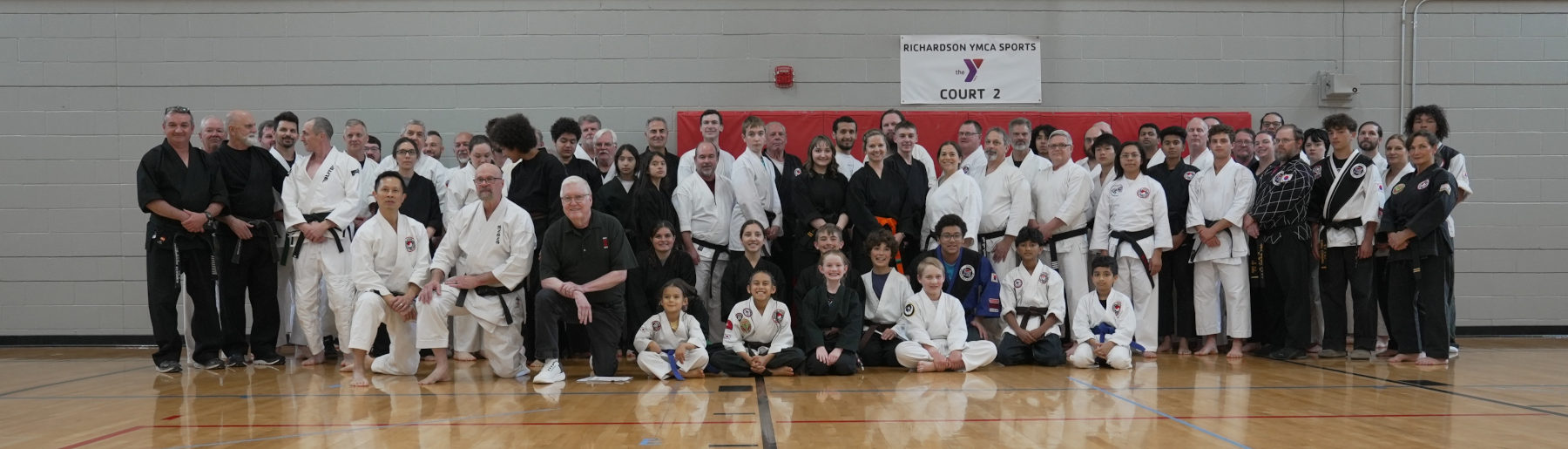
In 2016, during the American Karate and Taekwondo Organization’s 40th Anniversary, I had the privilege of leading a seminar and sharing some of that early material. It was my first AKATO banquet, and after a long week I was absolutely shattered. As GM Keith Yates began announcing Instructor of the Year, I slowly realised he was describing someone who sounded very familiar. I was stunned when he called out my name. As someone who teaches a small, tight‑knit group, the honour meant more than I can express.
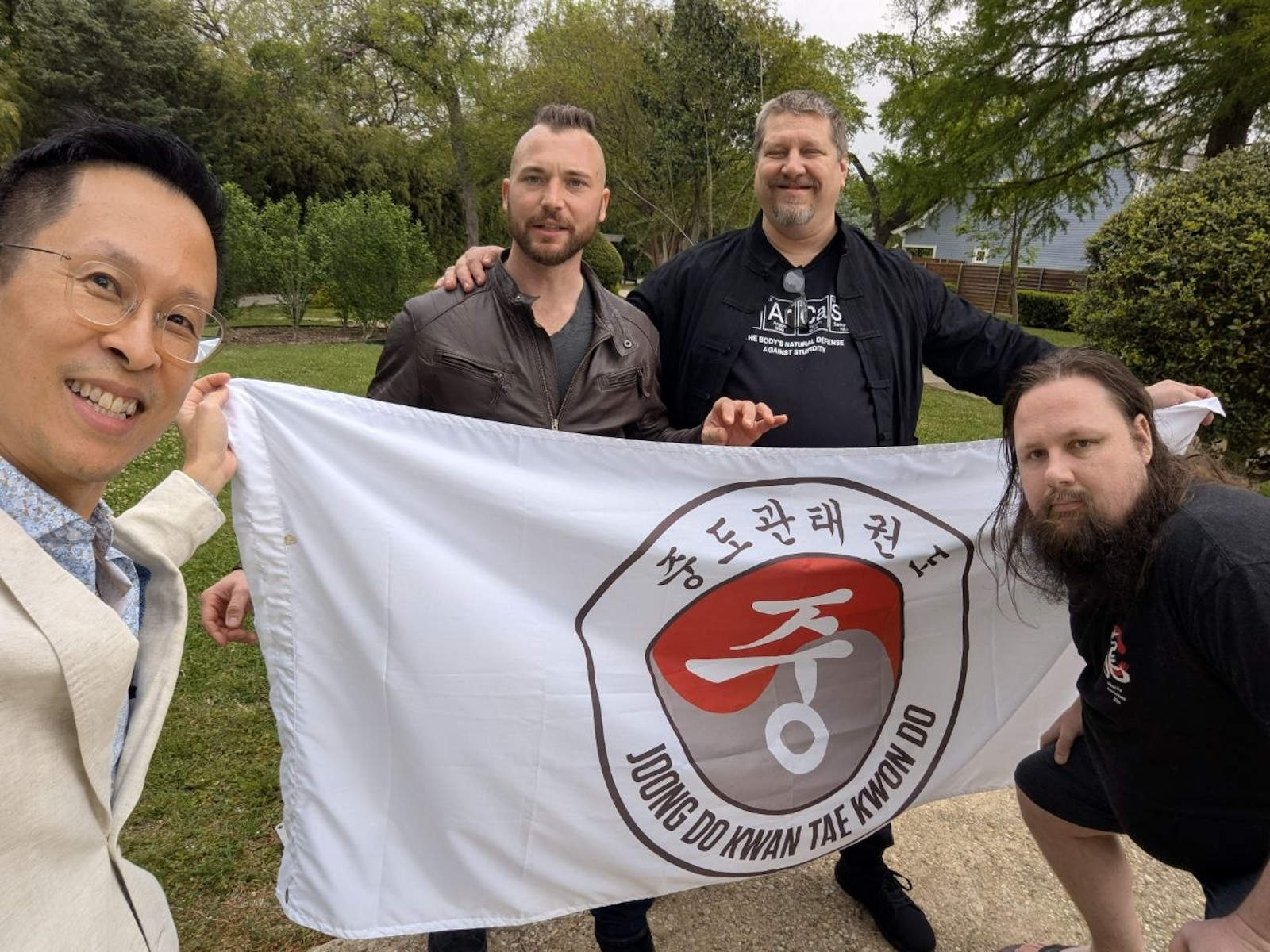
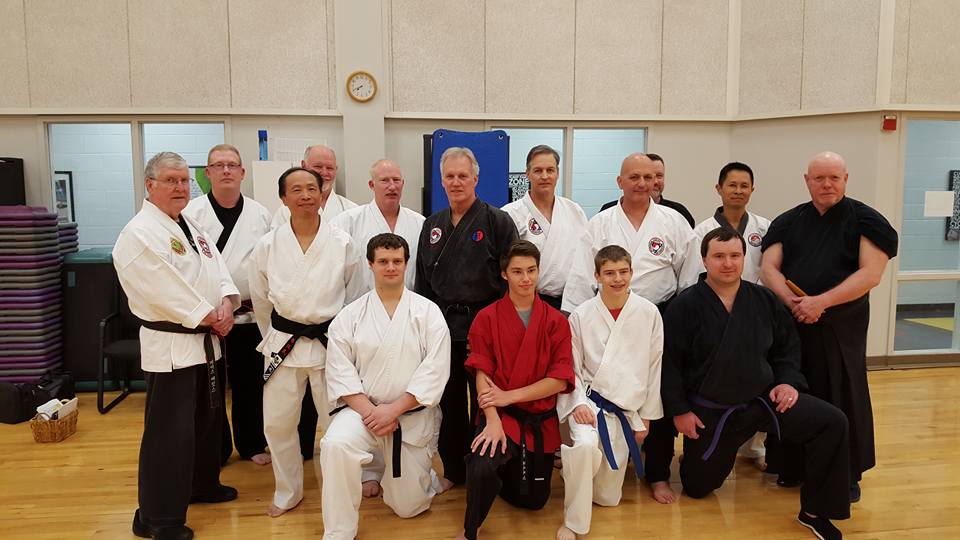
I remain deeply grateful to GM Yates for his kindness and encouragement, and for inviting me back to Dallas more often. Having both my instructors there, Bryan Robbins (RIP) and GM Mike Proctor, made the moment even more meaningful. And the friendships formed that weekend have stayed with me ever since.
A decade later, I returned to lead a seminar for AKATO’s 50th Anniversary, another huge honour, and a reminder of how blessed I’ve been to be welcomed into this family.
Bio: Colin Wee is a Singaporean author, martial‑arts instructor, and cultural historian whose four‑decade practice spans Asia, Australia, and the United States. Known for his analytical approach and deep tactical insight, Colin blends historical research with lived experience to illuminate the human stories behind martial traditions. He is the founder of Joong Do Kwan in Perth, Western Australia, and serves as Secretary of the Australasian Martial Arts Hall of Fame (see About the Author).
You can get a copy of Breaking Through: The Secrets of Bassai Dai Kata from Amazon or directly from the author at Ingram Sparks.
While working on the Patreon articles supplementing Application 3 in Breaking Through: The Secrets of Bassai Dai Kata, the first article A JDK Perspective on Kata, Human Variability, and the Insight of the Pioneers drew parallels between our insight into kata analysis, the human condition in combative exchanges, and the life circumstances of martial art pioneers.
The article attributed our increasing insight to years of watching how students assimilated our training and how their decision‑making preferences emerged during exchanges. With that discussion in mind, I went searching for photos that might represent that period of time, photos that would capture the moment when everything changed.
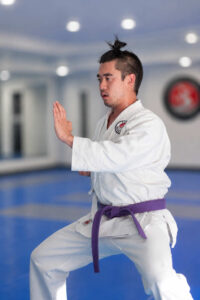
The photos I stopped at were of JDK Black Belt Joshua Lay, then a 4th kyu student during his grading in 2014.
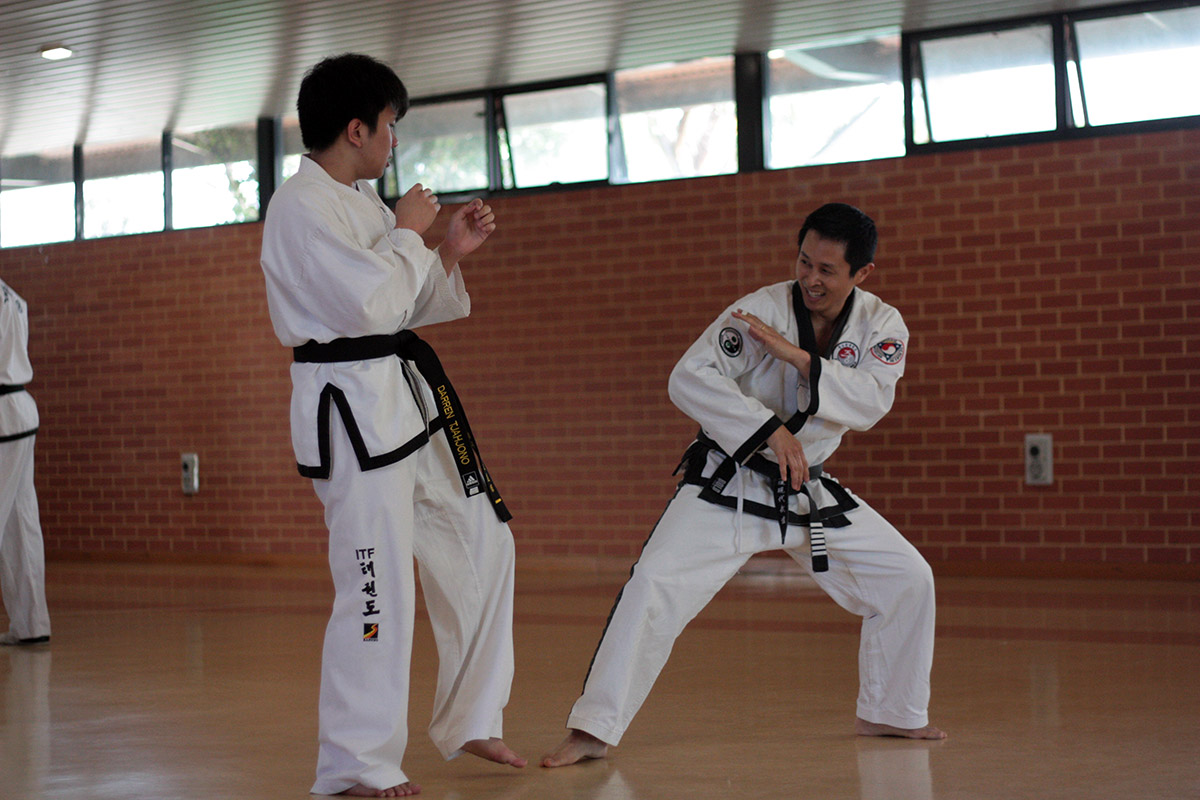
JDK BB Niaal Holder refs one of the many sparring encounters Josh had to endure that day.
They were taken at a turning point for Josh, and they mirrored an event horizon within JDK that eventually led to the JDK Method. But more importantly, they marked a turning point for me as an instructor.
Up until then, Josh struggled with the syllabus. Everything we presented seemed not to match his learning style. He attempted techniques and applications, only to completely forget them the lesson after. Yet a switch occurred for him at 4th kyu, when we introduced a type of randori we call Superlight, a slow, collaborative, and most importantly, free‑flowing exchange in an ultra-safe environment.
We had a total of seven practitioners come to play.
Something clicked. When he realised we weren’t trying to force him to remember specific moves, but to understand concepts, things happened all at once: the read of distance, the control of the opponent, and the essence of a tactic just came together. From there, it became easier for him to feel what was happening and then make sense of the process flow we needed to see.
Up until this point, JDK had gravitated to using patterns as a syllabus for about ten years. We had not yet embarked on my book project, which would become a five-year adventure. But the adoption of Superlight closed the loop for us. Deconstructing kata, varying the technique, and applying tactics in two-person drills were our fledgling efforts in celebrating traditional form. Superlight was what allowed us to test our assumptions in a dynamic situation. The feedback it provided allowed us to gauge the worth of our ideas. Distancing. Angles. How to stitch tactical elements together. Everything.
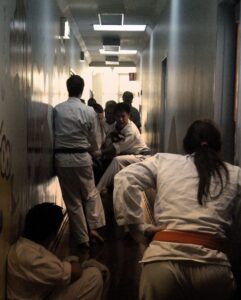
JDK BB Niaal Holder’s BB Grading in 2011 where he had to push through ‘The Gauntlet of Pain’
Two years before these photos, in what I thought was a stroke of genius, I set up a challenge for my then senior student Niaal Holder’s black belt grading. At one point during the grading, I had all our students stand in a corridor holding body shields and kick pads, and made him fight his way through the gauntlet while they actively tried to stop him.
Without thinking too hard about it, I felt it was only right to introduce a challenge for Josh that would match or exceed Niaal’s grading, you know, just to be fair. An email was sent to a few friends who headed up different martial arts schools, asking them to send a few volunteers to help.
Fortunately, my friends trusted me and had enough faith in what I wanted to achieve. On the day, I was absolutely delighted to have seven strapping black belts from Okinawan Karate, Chinese Martial Arts, Muay Thai, and Taekwondo backgrounds come to spar Josh.
Josh was still required to tick off his grading components, so we split the sparring into three parts, allowing everyone to see how he was faring while being brought to the edge of physical exhaustion. We also factored in time so our guests could spar each other too, ensuring they’d leave with good memories from the session.
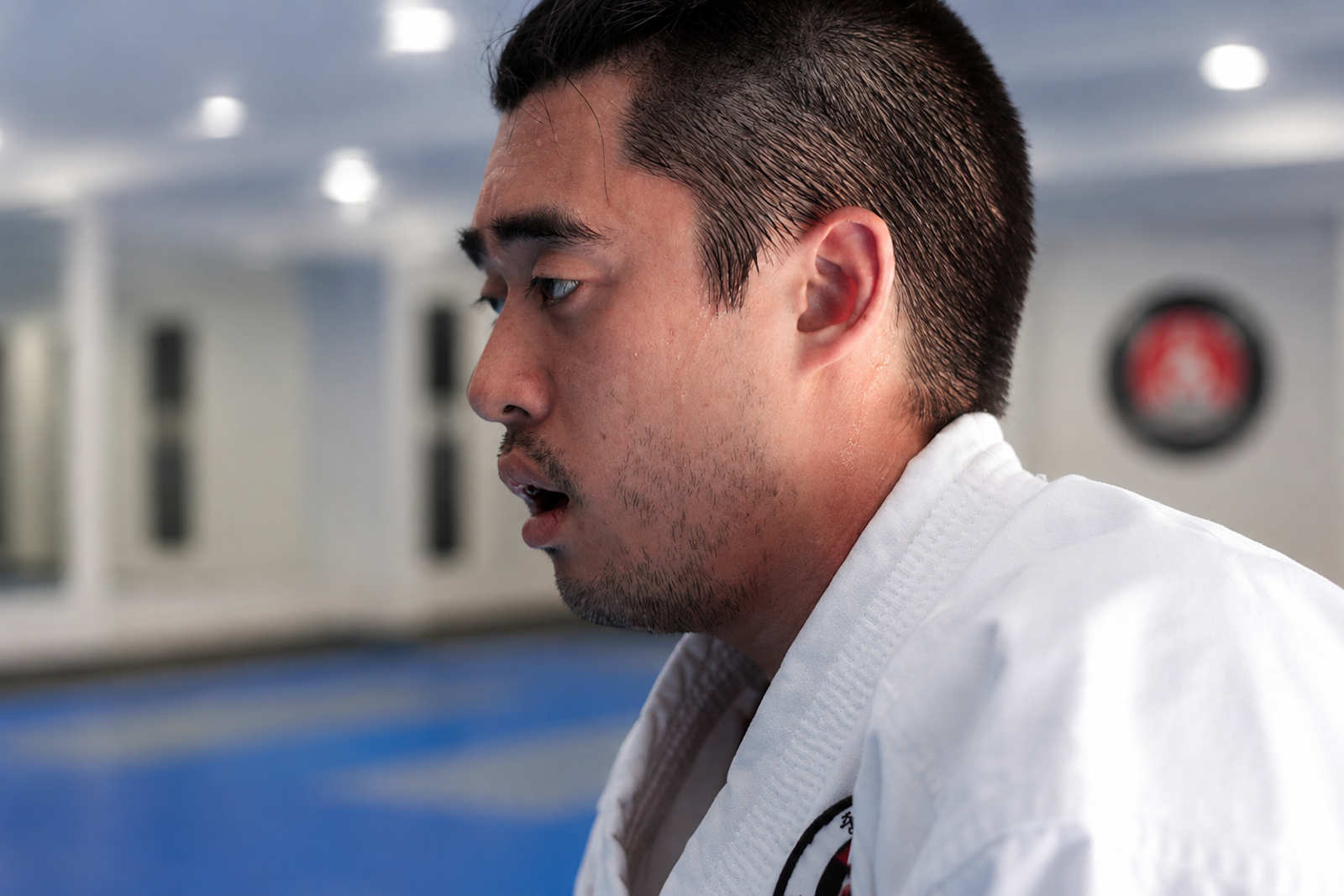
Joshua Lay in his 4th Kyu Grading demonstrates either Yulgok or Hwarang. Look at the exhaustion on his face.
With my instructor’s hat on now, I’ll just come out and say it: there’s a time and a place to push yourself. Something like this doesn’t necessarily need to be in a grading. I conceived the initial “Gauntlet of Pain” because Niaal had been plagued by self-doubt, and believed a black belt test had to be a brutal trial by fire. To have such a test for a 4th kyu purple belt was not necessary.
The entertainment was, without a doubt, next level. They each knew what we were trying to do, were aware that safety was a priority, and they all allowed themselves to play. By ‘play’ I mean they engaged in a competitive yet collaborative manner, and that allowed everyone to show off the best of their training. I was blessed to have spectated that day.
And looking back now, these photos do more than capture a grading. They capture the moment when I was happy to let go of some of JDK’s early hard style assumptions. The moment I realised that pushing students to the max: testing their endurance, their pain tolerance, their ability to “survive” wasn’t the acid test of how good martial arts were really taught.
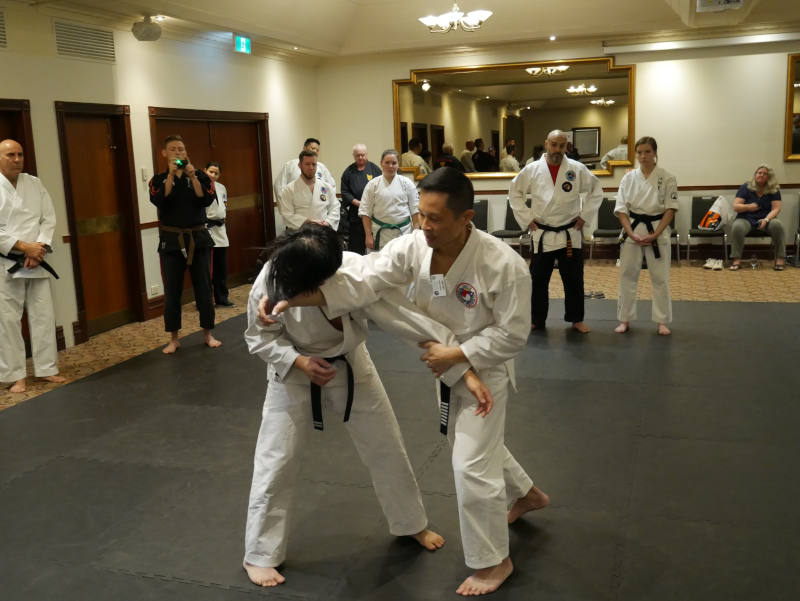
Josh Lay 4th kyu grading 2014 as he demonstrates applications from his patterns.
The pioneers didn’t build their systems around impossible hardship. They built them around sensitivity. Around strategy. Around safety. Around understanding how humans behave under pressure.
These photos show the moment I let go of my own hubris and finally understood that.
And those themes of human variability, the emergence of natural movement, and the advocacy of sensitivity and strategy are explored across the three articles from my Patreon’s coverage of Application Three.
Breaking Through Application Two, Full Article Series:
Bio: Colin Wee is a Singaporean author, martial‑arts instructor, and cultural historian whose four‑decade practice spans Asia, Australia, and the United States. Known for his analytical approach and deep tactical insight, Colin blends historical research with lived experience to illuminate the human stories behind martial traditions. He is the founder of Joong Do Kwan in Perth, Western Australia, and serves as Secretary of the Australasian Martial Arts Hall of Fame (see About the Author).
You can get a copy of Breaking Through: The Secrets of Bassai Dai Kata from Amazon or directly from the author at Ingram Sparks.
I’ve recently launched a Patreon account so I could return to the applications seen in Breaking Through: The Secrets of Bassai Dai Kata. I wanted to share the deep dives into my ongoing research on traditional martial arts, including expanded photo sets, application breakdowns, and long‑form reflections that don’t always fit neatly into a standard blog post.
Since the launch of the book, we’ve had lots of great video from seminars and workshops. These are perfect to supplement the static photos in the book, and Patreon members get to see applications direct from the events we’ve held to celebrate the book.
The article below is one of the free pieces featured there, presented here in full on this blog. Patreon supporters get access to the extended series this article belongs to (see the links below), along with access to premium content and behind‑the‑scenes material from my current projects.
Right after a sparring session a few years ago, one of the black belts approached me and asked where I’d learned the hand skills I was using in our exchange. “Was that Wing Chun?” he asked. “Actually, it’s Traditional Taekwondo.” He didn’t believe me.
For nearly two decades my school and I have been analysing traditional martial arts patterns. This wasn’t reverse engineering, that is we weren’t trying to make old movements fit modern preferences. It was functional analysis aimed to reconstruct historical skills, or at least imagine what they were designed to achieve.
Take Bassai’s three middle‑block sequences. Our goal was never to justify the pattern. We wanted to absorb the technique phrase into our working vocabulary so we can use, test, and refine its tactical worth.
Is that a block, a strike, or a double strike – Colin at AMAHOF 2022 small
To explore the technique, we stand in front of an opponent who throws a slow attack, which we deflect. Then a slow combination, which we also deflect. As our ability improves, the difficulty of the attack increases. Eventually the two‑man exchange approaches full speed, and we can then move testing into an unscripted combative exchange. This is not done at full pace; both partners move proportionately to the other. This free‑flowing and ultra-safe environment lets us study whatever technique against a live opponent, and helps with the ongoing functional analysis.
This unscripted exchange has shaped our pattern analysis more than anything else. We’ve learned that every slice of motion can be used to deflect, cover, or strike. With a wide-ranging remit, we take aspects of the middle block, for example, using it to deflect a straight cross, and drill it, running variations upon variations. We do the same with the knife‑hand guarding block, the twin‑fist block, even an elbow strike. Eventually techniques blur and blend, becoming simply the read of distance, timing, angles of entry, and the expansion of your physical structure to connect with the opponent.
After my first book, I found myself writing a story set in 19th‑century Ryukyu, during the Japanese subjugation of the islands. The cultural pressure and financial hardship pushed former bureaucrats to develop a new training system called karate. As I researched the personalities and consolidated the historical canon, I began to understand how deeply Chinese martial arts, culture, and food influenced Ryukyu. That pushed me to study Chinese‑based systems and expand on the basic concepts I’d explored in my first book.
As opportunities arose to explore Chinese‑based systems, I found concepts that immediately clarified gaps I’d carried for years. The idea of fajin, and the broader principles of internal energy manipulation, offered powerful analogies for kinetic chaining and kinesthetic movement. They revealed how leverage, structure, and intent could be directed through the body to destabilise an opponent.
Even a basic understanding of soft-style principles have given me a deep appreciation of how muscle control, structure, and intent could be used to destabilise an opponent. Hard‑style training had always hinted at these dynamics, but here they were expressed cohesively, with a precision that made the underlying mechanics unmistakable.
Q. Is there a counterpunch in the technique, Mr. Miyagi? A. Ask drum
Behind-the-scenes at photoshoot for the book
With the middle block, the external training is still useful as it trains the practitioner to run interference on the opponent or weave through their defences. But inside the movement there could be more: the soft-style relay of waveform energy from the ground, through the body, into the opponent.
The middle block could be dismissed as arms waving in the air. But the hands should be waving, and transmitting the ground force travelling through the body. When the middle block connects, you’re sending that entire waveform through the opponent. Do you send it as a vertical pulse? Do you shake the tree? Do you float him while striking? Do you sink the energy so his hips collapse?
Or has the opponent trapped your limb, and you’re using the middle block to disrupt his centre of gravity before countering with a blitz?
When that black belt asked if I was using Wing Chun, he wasn’t wrong to see something unfamiliar. What he saw wasn’t a different style, it was the result of twenty years of digging beneath the surface of my own tradition. The forms gave me the entry point, but the real lessons came from what was there before the form: the centreline control, the kinetic chaining, the soft‑style leverage, the waveform mechanics that had never been spoken of aloud. I certainly didn’t set out to reinvent anything, and I never chased other arts to fill a gap. I simply followed my practice until it led me here, to a place where the form is no longer the destination, but a doorway to the lessons it always meant to teach.
Breaking Through Application One, Full Article Series:
Bio: Colin Wee is a Singaporean author, martial‑arts instructor, and cultural historian whose four‑decade practice spans Asia, Australia, and the United States. Known for his analytical approach and deep tactical insight, Colin blends historical research with lived experience to illuminate the human stories behind martial traditions. He is the founder of Joong Do Kwan in Perth, Western Australia, and serves as Secretary of the Australasian Martial Arts Hall of Fame (see About the Author).
You can get a copy of Breaking Through: The Secrets of Bassai Dai Kata from Amazon or directly from the author at Ingram Sparks.
Bassai Dai’s Opening Sequence now Featured on Patreon
When I published Breaking Through: The Secrets of Bassai Dai Kata, we had captured a snapshot of insights from our multi‑year deep dive into the form. What I didn’t expect was how much more we would grow since writing the book.
While a huge amount of effort was invested, every application in the kata has layers that didn’t make it into publication. The book’s print format couldn’t contain everything. My publisher GM Mike Swope (RIP) from Moosul Publishing Inc. even floated the idea of producing DVDs to complement the applications. At the time, that wasn’t feasible.
But now, Patreon provides an opportunity for us to take this project to the next level.
Patreon gives me the space to revisit each application, add material that couldn’t fit into the book, and present ideas and further insights through photos, seminar clips, coaching analysis, and long‑form explanations. It’s the perfect channel that Bassai Dai and Breaking Through deserves.
This blog post introduces the first instalment of that journey on Patreon: Application One, Full Article Series.
Why Application One Needed More Than the Book Could Offer
Most hard style practitioners perform kata thousands of times without ever asking what value it actually offers, or accept without question the very sparse and limited explanations when questioned of its functionality. Bassai Dai’s opening sequence (Step 1a–1b), for instance, is one of the most underrated parts of the kata, relegated to being a simple wrist release skill.
When I wrote the book, I had to make hard decisions:
Which photos to include
Which applications to prioritise
Which sequences served the broader learning pathway
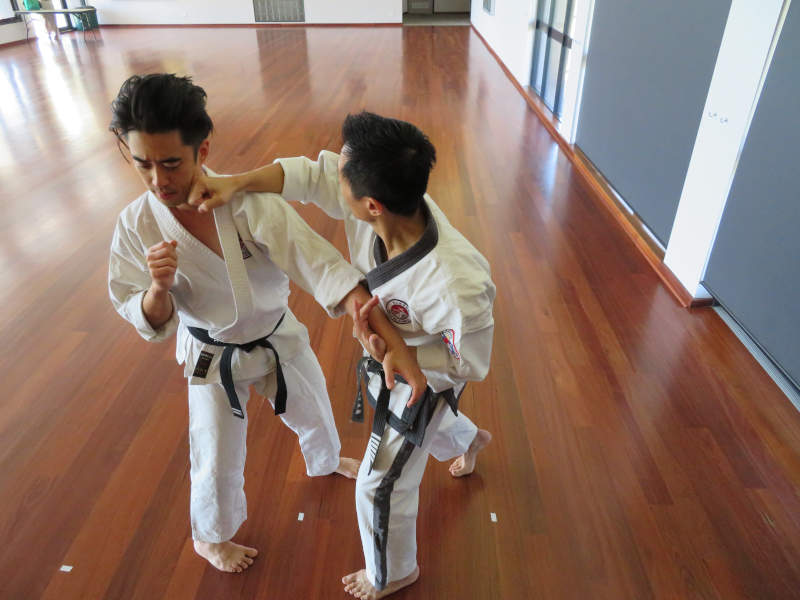
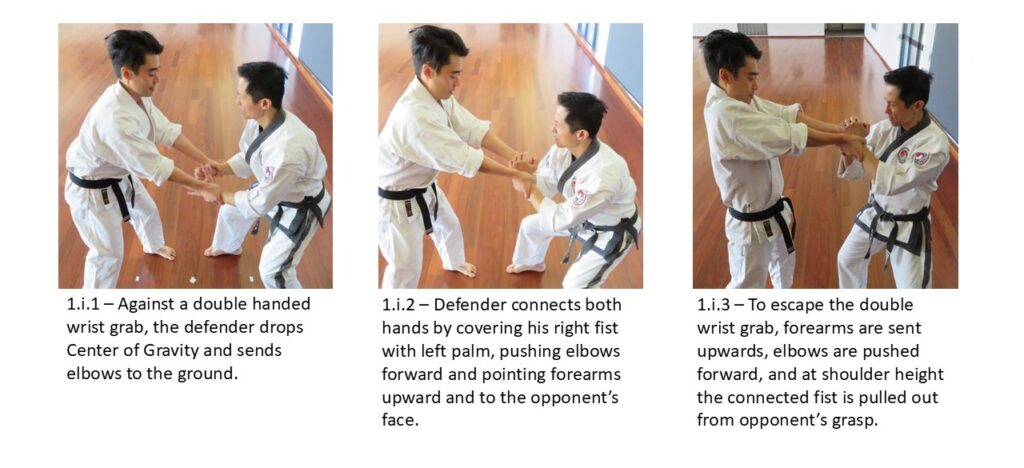
Some material that perfectly matched the kata, including a wrist‑release sequence that mirrors Step 1a–1b, didn’t even make the final cut. Not because it lacked value, but because it didn’t fit the pedagogy of the book.
Patreon allows me to restore that material, explain why it matters, and show how it connects to the rest of Application One.
Why Patreon Is the Right Platform for This Work
A book can only do so much, and this is the kind of content that simply doesn’t fit neatly into print. It needs space. It needs multimedia. It needs time. Fortunately, Patreon gives me all of that, and gives readers a way to follow our journey with Bassai Dai in real time.
Breaking Through Application One, Full Article Series
Application One begins with a jab-cross defence, moves into a head‑capture sequence, and a takedown of the opponent. The Patreon series expands this significantly.
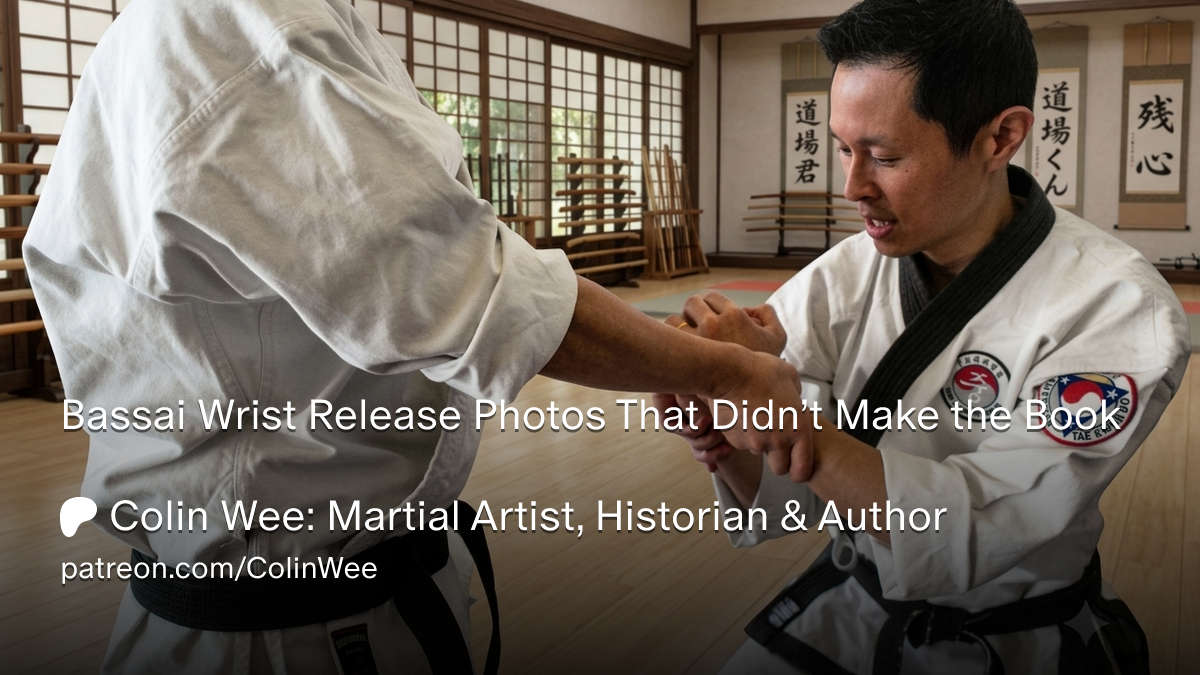
1. Free Article: Bassai Wrist Release Photos That Didn’t Make the Book
A behind‑the‑scenes study of the photos that mirror the opening sequence of Bassai Dai kata, why they didn’t make it into Breaking Through, and why they do matter.
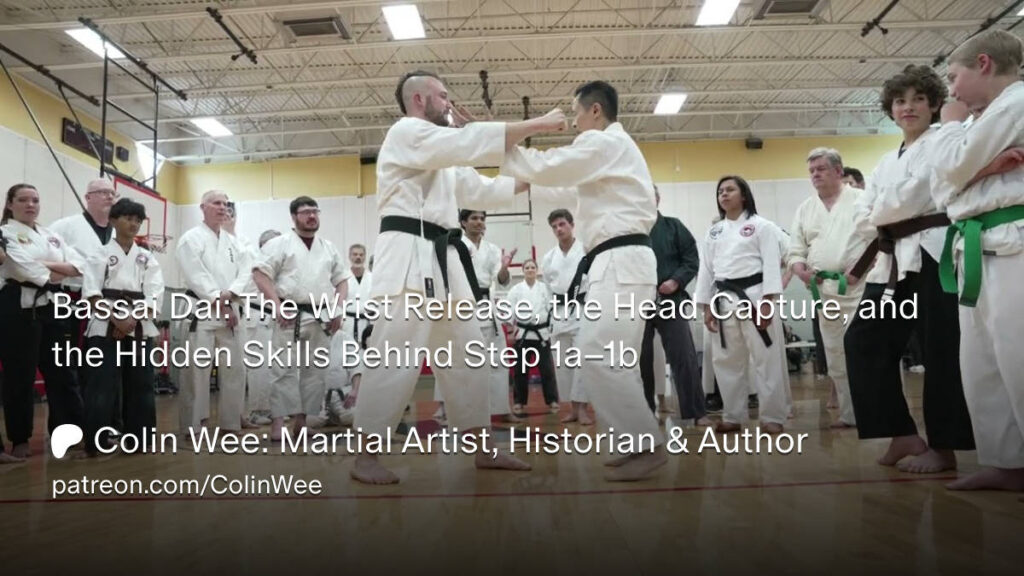
2. Premium Article: Bassai Dai: The Wrist Release, Head Capture, and Hidden Skills Behind Step 1a–1b
Bassai Dai Application One Hidden Skills shared in Seminar Video through Patreon https://www.patreon.com/ColinWee/posts/bassai-dai-wrist-165716897
A full breakdown of the application, including:
exclusive seminar video
photo sets
structural mechanics of kata and bunkai
footwork logic
how the practitioner controls opponent’s mass
3. Free Article: Training for Multiple Opponents in a Hard Style Context
Bassai Dai Application One Against Multiple Opponents
How awareness and movement apply when facing more than one adversary, including:
environmental awareness
spatial control
unexpected relevance from a soft style practice
Together, these three articles form the complete expansion of Application One to complement the material in the book. They provide material that didn’t fit into the book and the material that evolved after publication.
Why This Matters for Hard‑Style Practitioners
Hard‑style training often emphasises line drills, fixed stances, predictable sequences, single-opponent exchanges, and a reliance on strength and endurance to win the day. But Bassai Dai encodes skill Ryukyuan fighters needed for castle defence, not dojo sparring. Their combative approach required a depth of ability that can immediately enrich your hard style training. With Breaking Through Application One, Full Article series you can take the shortcut along the learning curve, and tap directly into the insights from our journey.
Where to Read the Full Series
Start with the two free articles:
Bassai Wrist Release Photos That Didn’t Make the Book → [link]
Training for Multiple Opponents in a Hard Style Context → [link]
Then explore the full premium series:
Patreon Premium: Breaking Through Application One → [link]
The Book Was the Beginning, Not the End
Bassai Dai is not a relic. It’s not choreography. It’s a protocol, a training approach that reveals more the deeper you go.
Writing the book opened the door. Patreon now lets both you and me walk through it together.
Bio: Colin Wee is a Singaporean author, martial‑arts instructor, and cultural historian whose four‑decade practice spans Asia, Australia, and the United States. Known for his analytical approach and deep tactical insight, Colin blends historical research with lived experience to illuminate the human stories behind martial traditions. He is the founder of Joong Do Kwan in Perth, Western Australia, and serves as Secretary of the Australasian Martial Arts Hall of Fame (see About the Author).
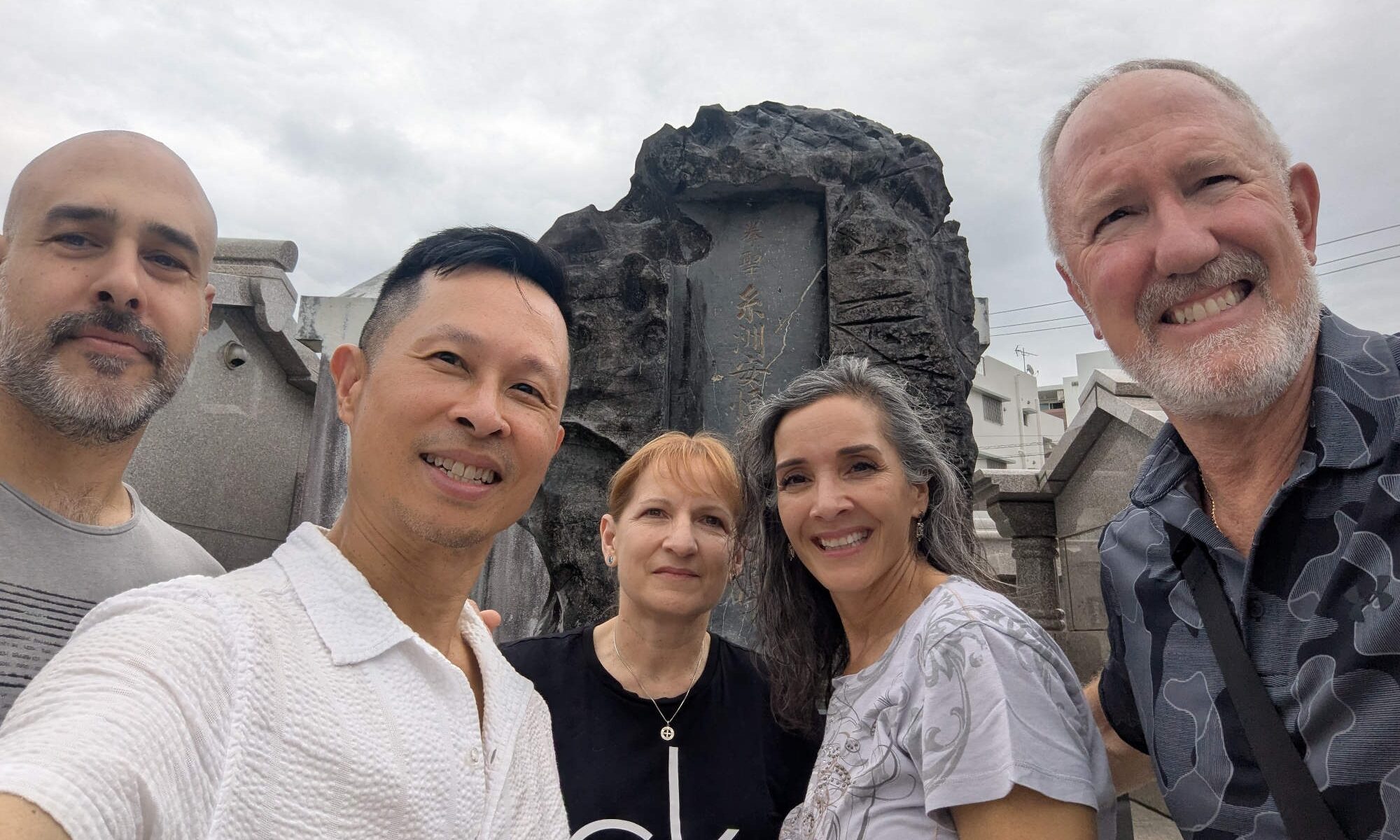
An international group of martial artists converged in Naha on 25 October 2025 to drink in the sights, practice martial arts, enjoy Ryuku Awamori, breathe in island life, and experience International Karate Day. The group, led by Colin Wee were intending to trace the steps taken by karate pioneers Itosu Anko and his mentor Matsumura Sokon. See Colin’s related article that foreshadows the tour How Jion Reshaped my Training and Led me to Anko Itosu.
It was amazing to have a group of high-level martial artists trusting me to plan this tour – taking a leap of faith purely based on my work on Okinawa and its history. While I planned the trip to have breadth and depth, to get this incredible commendation from Shihan Leonard was very gratifying! Thank you, Leonard! A 5-star review is always amazing, but more so impressive considering this trip was the first tour I’ve ever organised.
Have you planned a martial arts tour before? I would love to hear your experiences.
This clip was filmed during my official induction into the Australasian Martial Arts Hall of Fame, an event delayed from 2020 until borders were reopened. Western Australia had been fortunate during that period; while the world was locked in, life continued with relative freedom, and I had the luxury of continuing my preparations for the demonstration and seminar portion of the AMAHOF weekend.
Many who watched my demo later shared with me they were expecting aerial kicks and acrobatics, the spectacle people associate with Taekwondo. What they saw instead was something far more traditional, and far more reflective of the work my school had been immersed in for years.
What do you expect from a martial arts seminar?
Jion Bamboo Forest Colin Wee 2023
My usual explanation is I wanted to share traditional applications, or perhaps I was demonstrating whatever my school happened to be practising at the time. The truth was that I’d been deep in the rabbit hole for many years leading up to this point. In the late 2010s I pulled my school into an intense, single‑kata focus. When COVID shut the world down, and when we realised how much insight that deep dive had produced, we finally gave in to the idea that had been circling around for years: this needs to become a book.
Motivated by our phenomenal progress, I switched tracks and plunged into the next kata Jion. Supporting me was the last remaining black belt at JDK. While I could say COVID decimated my school, the reality was that training one kata day‑in, day‑out was not for everyone.
How do you ‘find’ bunkai?
Our process is demanding. When we explore a kata or a combative system, we deconstruct every facet of it. We break it apart, test it against a non‑compliant opponent, rebuild it, and repeat. By the time this video was filmed, we had spent nearly three intense years taking Jion on a wild ride. And then we reached an event horizon: when we took stock of Jion, we were shocked to find at a high level it was nothing like Bassai. For those who don’t already know, Bassai was the kata that formed the backbone of my first book, Breaking Through: The Secrets of Bassai Dai Kata.
The Jion seminar at AMAHOF 2022 was when we were standing at the cusp of embarking on an amazing journey back into the beginnings of hard style martial arts.
How do you start writing a Martial Arts Book?
That realisation forced us into frenzied research. Pulling on Jion’s threads was what led to unexpected discoveries about the pioneers of our martial art. One insight led to another, and before long an entire historical tapestry fell into view. It was then I knew I owed it to the world to begin work on Anko: The Lost Scrolls of Ryukyu.
I was apprehensive not quite believing I had the chops to adequately deliver the story. It was an epic beginning with the Japanese subjugation of Ryukyu in the 19th century, and culminating with beleaguered ex-bureaucrats attempting to preserve their culture by developing karate as a training program for the century ahead.
Acquiring Soft Power in Martial Arts
If you watch the demonstration, you can see my search for precursor know-how had influenced my own practice. My abilities were clearly shifting, though it wasn’t a deliberate move on my part to emulate the Ryukyuans. My research had led me to postulate their goals, and that required the retrofit of hard‑style and soft‑style skills back into kata and application work.
From 0:02–0:08, you can see me working through an application to bypass the tangle of arms – while my partner was deliberately offering active resistance. I remember noticing the difficulty as I narrated; eventually I had to trust my senses to take over, read his movement, bypass the resistance and displace his structure for the takedown.
What this is is me dealing directly with my opponent. I’m not “demonstrating” Jion nor trying to prove how closely my skills resemble its sequences. Yes, I’ve worked with Jion’s technical sequences. I’ve also varied them endlessly. And when the adversary opposes them, I naturally circumvent and bypass the obstruction instinctively. The read of the situation and response to the unscripted, dynamic attack come easily – because that is what the training helps you do. Jion informs the initiative, it does not limit it.
Likewise, I could have written another non-fiction book laying out a sequence of historical facts. I could have stuck rigidly to historical cannon, the way many insist application bunkai must resemble the kata. But would that do justice to the story though? Or is it more meaningful to feel their journey, like the way I’m now pushing past hard-style training into soft-style tactics.
That, I believe, is the truth martial artists actually want.
Bio: Colin Wee is a Singaporean author, martial‑arts instructor, and cultural historian whose four‑decade practice spans Asia, Australia, and the United States. Known for his analytical approach and deep tactical insight, Colin blends historical research with lived experience to illuminate the human stories behind martial traditions. He is the founder of Joong Do Kwan in Perth, Western Australia, and serves as Secretary of the Australasian Martial Arts Hall of Fame (see About the Author).
Waneroo, Perth, 2 Dec 2024. Kyoshi Peter Hunt hosted a session to explore concepts in the book Breaking Through: The Secrets of Bassai Dai Kata. In that seminar, we looked at the underlying thought process which led to the publication which we referred to as “The JDK Method.”
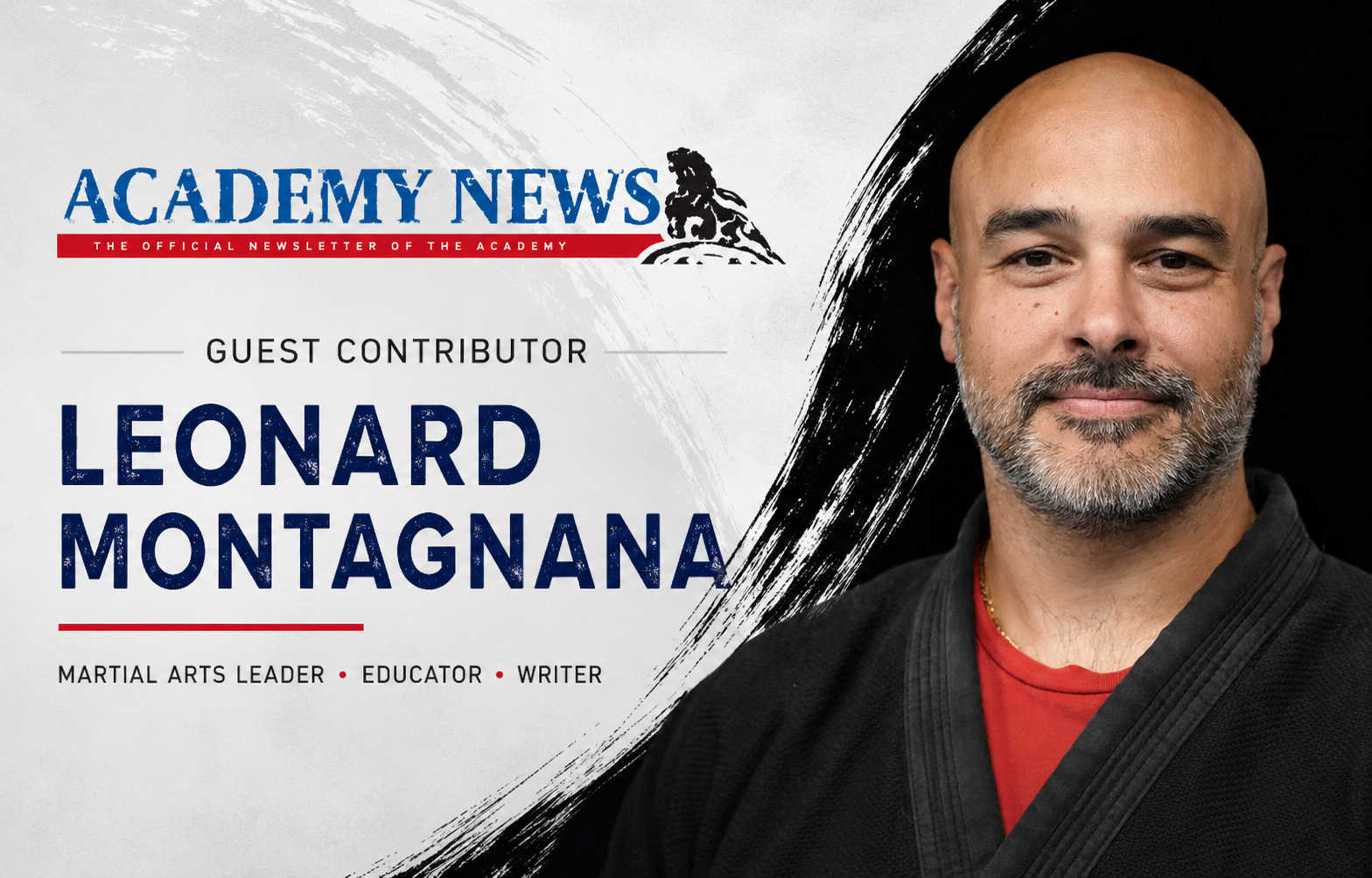
Guest Contributor Shihan Leonard Montagnana participated in the Wanneroo event, and we’re excited to share his report on AJJJCBFI’s Academy News Summer 2025 Edition #95 below.
The JDK Method is a distillation of two decades of work to answer the question “What is Bunkai?” It firstly considers the vagaries of preemption. Under duress, practitioners are hard pressed to read the combative landscape and accurately predict what is happening.
The other questions that may be asked are “What attack is coming my way?” or “Is it a left or right handed strike?” For this, we advocate for techniques to be used as multitools. Ideally, your one technique should apply to a left side attack, as does to a right side attack. Secondly, we assume failure of technique. The opponent is there to oppose you. Thus, it is to your advantage to prepare for that opposition. If resistance could shut down your tactic at any point, train for workarounds, and draw freely from your library of skills.
If you bunkai to you is simply one solution to one problem, you may need to revisit your training pedagogy. What is the end goal your training is leading you towards? Is it choreography? Or is it to acquire fight IQ?
The Breaking Through book eventually leads to the work on my historical fiction manuscript. For those practitioners who think a novel is beneath them, that operative word ‘fiction’ is there only so I may pick apart the facts from the truths. Stick with me, it’s going to be a compelling ride!
📖 Flip through Breaking Through here and then get your free Book Club Kit
Bio: Colin Wee is a Singaporean author, martial‑arts instructor, and cultural historian whose four‑decade practice spans Asia, Australia, and the United States. Known for his analytical approach and deep tactical insight, Colin blends historical research with lived experience to illuminate the human stories behind martial traditions. He is the founder of Joong Do Kwan in Perth, Western Australia, and serves as Secretary of the Australasian Martial Arts Hall of Fame (see About the Author).
During AKATO’s 50th Anniversary weekend in Dallas (March 2026), I taught a session that allowed me to share the research shaping Anko: The Lost Scrolls of Ryukyu. Much of my work over the past few years has involved reconstructing how Ryukyuan retainers combined hard‑style initiative with soft‑style internal mechanics, a blend that’s rarely seen in modern training.
The demonstration opened with an application drawn from Nam Seo Hyung: closing distance, prompting reaction, and using circular movement to create openings along the centreline. From there, the sequence branched into two close‑quarter variations inspired by Jion, each exploring a different way to manage the opponent’s structure: either through limb control or through neck manipulation, and balance disruption.
What is the difference between hard-style v soft-style martial arts?
For many practitioners in the room, this was unfamiliar territory. Hard‑style systems often emphasise direct power, while soft‑style methods rely on timing, whole‑body coordination, and subtle changes in pressure. Bringing these ideas together and showing how Ryukyuan retainers may have used them in real conflict, created some dramatic moments. With very little visible movement, my training partner’s balance was broken and his momentum carried him across the floor. In another variation, a circular pulse around the neck opened the way for a controlled takedown and a simulated weapons check.
What I hoped to share wasn’t a highlight reel of ‘lethal’ techniques, but a window into the research process: how historical context, body mechanics, and cross‑style exploration can reshape our understanding of a fighting system. Ryukyu’s retainers were small in stature, but they relied on efficiency, teamwork, and a fusion of ideas to maintain advantage in asymmetrical situations. That blend continues to fascinate me, and it’s a core part of the world behind Anko: The Lost Scrolls of Ryukyu.
If you’d like to see a portion of the Dallas session, the video is available at:
Bio: Colin Wee is a Singaporean author, martial‑arts instructor, and cultural historian whose four‑decade practice spans Asia, Australia, and the United States. Known for his analytical approach and deep tactical insight, Colin blends historical research with lived experience to illuminate the human stories behind martial traditions. He is the founder of Joong Do Kwan in Perth, Western Australia, and serves as Secretary of the Australasian Martial Arts Hall of Fame (see About the Author).
Perth, Western Australia, May 2025: Editor David Moore and myself are videoed talking about our project The Lost Scrolls of Ryukyu. This project is inspired by true events which start with the annexation of Ryukyu in the 19th century, and leads us to then track the lives of a few martial art masters affected by the cultural subjugation.
If you’ve read Breaking Through, you’d probably see the throughline. The Lost Scrolls is me adamant once more to follow the breadcrumbs back in time. Breaking Through had done its job looking at what was bequethed us, but it stopped way short of looking at the lived experiences of the architects of our martial arts.
As I gained an appreciation for the enormity of this story, I never felt more compelled to finish what my first book had started.
I’d love to hear what you think. Would you expect a historical fiction novel to teach you anything about martial arts? Would you be interested to read about the pioneers of your martial arts set in a fictionalized story? If you’re on Goodreads, drop a question there.
Bio: Colin Wee is a Singaporean author, martial‑arts instructor, and cultural historian whose four‑decade practice spans Asia, Australia, and the United States. Known for his analytical approach and deep tactical insight, Colin blends historical research with lived experience to illuminate the human stories behind martial traditions. He is the founder of Joong Do Kwan in Perth, Western Australia, and serves as Secretary of the Australasian Martial Arts Hall of Fame (see About the Author).
Etiquette plays a crucial role in shaping the mindset and environment that support effective martial training, including mental visualization.
Following etiquette helps you enter the training hall with intention. Bowing at the door becomes a physical and mental ritual to set aside daily concerns and step into a focused, reverential space. This ritual marks the transition from the outside world to the practice floor, preparing you to be present and ready.
Etiquette builds respect and discipline. When you treat the training floor, your instructors, and your training partners with consideration, you contribute to an atmosphere that encourages growth, learning, and mutual support.
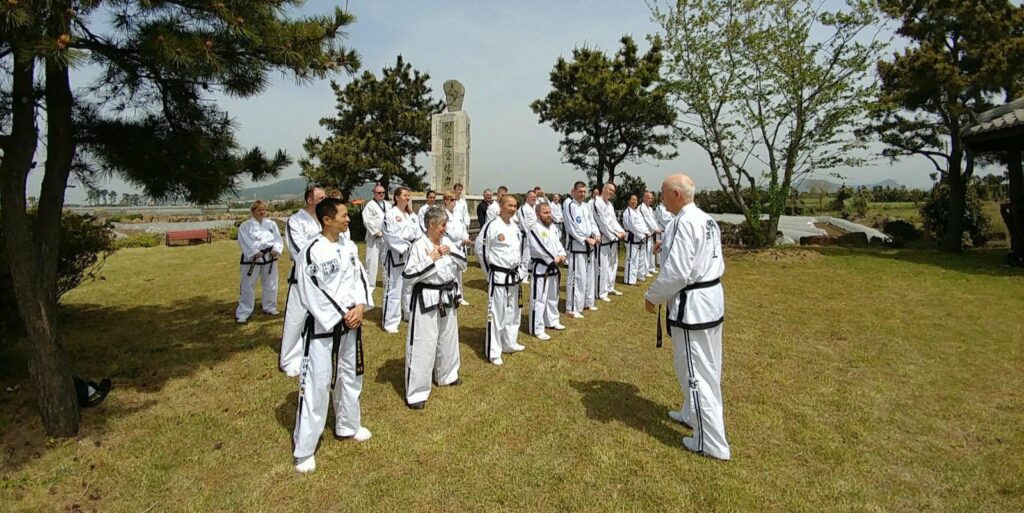
ITF Tul Tour 2018, 63rd Anniversary of Taekwon-Do Proclamation, One First Monument, Jeju Island, South Korea.
Just as importantly, etiquette establishes safety and trust. When everyone follows the same framework, you can train without distraction, knowing the environment is safe and predictable.
These rituals also help you shift smoothly between phases of training. Bowing to a partner or observing prescribed forms primes your mind to absorb instruction, respond to feedback, and engage with clarity.
Etiquette works hand‑in‑hand with mental visualization training. By rehearsing techniques with both your body and in your mind, you strengthen the neural pathways that support muscle memory, improve focus, and sharpen tactical awareness. Mental visualization let’s you bring the best parts of your yourself with you wherever you go.
Etiquette is not meant to make you uncomfortable or change who you are. Don’t let the guidelines discourage you. Learn them for the lessons they teach, they exist to help you train with intention, respect, safety, and clarity.
General Etiquette Guidelines
Arrive early to warm up before class; inform your instructor in advance if you can’t come, disclose any pertinent issues to your instructor which might affect your performance or safety whilst practicing.
Review material from previous classes.
Wear a clean and presentable uniform.
Ensure your feet are clean.
Practice personal hygiene.
Prioritize safety by using controlled techniques, seeking collaborative exchanges with training partners, keeping your fingernails trimmed short, removing jewelry, regularly exercising for strength and flexibility, getting enough sleep, and staying hydrated.
Avoid attendance if you are unwell; do not spread your illness to fellow practitioners.
Etiquette of Greeting Seniors
Upon entering the training hall, seek to first greet bow the highest-ranking instructor present, where possible. Then bow to each other instructor in descending order of rank. When approaching instructors, use formal greetings like their official organizational title, or the appropriate title for their specific martial art lineage (Sahbumnim for Korean arts, Sensei for Japanese arts, and Sifu for Chinese arts). When an instructor addresses you, respond promptly with “sir” or “ma’am,” avoiding informal language. If you don’t know the instructor’s name, use “Sir” or “Ma’am” until you can properly greet them by name.
Bowing Etiquette
Bowing is a form of greeting and respect, similar to a handshake. The angle and duration of a bow vary depending on the situation. The general bow is a 30-degree forward bow from the waist, lasting about 3 seconds. During the bow, men keep their hands flat on their sides, while women may place their palms on the front of their thighs. Avoid nodding your head and keep your eyes slightly lowered toward the angle of the bow. . If someone from a different culture bows to you in acknowledgment or greeting, it’s customary to return the bow. This may lead to a series of bows, depending on the situation. A 5-degree bow is a simple greeting or acknowledgement, 15 degrees is a common salutation, 30 degrees is a respectful bow to show appreciation, and 45 degrees signifies deep respect, extreme gratitude, or an apology.
Entering the Training Area
Before stepping onto the mat, place your footwear facing outward and off the mat. Bow before stepping onto the mat.
Starting Regular Class
After regular class starts, it is important to follow the instructions and commands given by the instructor. When the instructor signals the start of class, all students should immediately stop what they are doing and move into a standing formation based on seniority. The highest ranking student will give the commands for a standing bow, as prompted by the instructor.
Starting Formal Class
During formal class, the instructor will clap his hands to gather the attention of all students. At this point, students should stop what they are doing and move into a kneeling formation based on seniority. Assistant instructors or guests will position themselves on the side left edge of the room, facing both the instructor and the students. Students will then wait for the commands to follow a kneeling bow to the flags or kamidana, bow to the instructor, and bow to the assistant instructors.
To kneel properly, make sure there is a fist width between your knees and cross your right toe over your left. Keep your back upright and rest your palms on your thighs. When bowing, hinge from the hip, extend your left hand in front of you, followed by your right hand, forming a diamond shape on the floor. Lower your head to about a hand span above your hands. When sitting back up, pull your right hand up first, followed by your left hand.
Recitation of Tenets or Precepts
During the class, there may be a recitation of precepts or tenets led by the instructor or assistants. Pay attention to these recitations and be aware that different schools may have variations in the specific wording.
On Lateness and Punctuality
If you arrive late to class due to circumstances beyond your control, enter the dojang quietly and wait at the edge of the mat. Wait for an instructor to acknowledge you before bowing in and quietly joining the class. Being punctual is important, as habitual tardiness can disrupt the training environment and is disrespectful to fellow students.
Talking in Class
While in class, it is important to maintain a focused and serious attitude. Avoid extraneous talking, coaching, or commenting on other students’ techniques, unless it is necessary for safety or constructive feedback. If you have observations or difficulties, discuss them in a respectful manner that does not disrupt the class or interrupt the instructor.
On Having Fun
Remember to enjoy yourself during class, but always work with dedication and effort. Follow the instructions given by your instructor and strive to repeat the techniques as demonstrated, without modifying them unless specifically encouraged to do so.
Following Training Instruction
If you have any concerns about the training, do not request special treatment, challenge opponents, argue with the instructor, or compare different instructors. Instead, communicate with your partner about any safety issues or discuss the matter with the instructor when appropriate.
Walking Around a Group
When moving around the training area, be respectful and mindful of others. Choose to cross behind people who are practicing, seated, or waiting for instruction. Never cross between the instructor and the students he is teaching, unless you are physically unable to do so. In that case, apologize and cross while holding your right hand in front of you, palm facing left, and lowering your head.
Begin and End with a Bow
Always begin and end any practice or interaction with a bow. Before engaging in practice with your partner, bow first. When finished, bow to conclude the session. If you are asked to assist the instructor with a demonstration or as a partner during the lesson, approach the instructor, bow, and stand ready for instruction. If the instructor turns away from you, drop to your left knee with your hands folded on your right. When the instructor turns back to you, quickly get up and assume the ready position until told otherwise.
Working Collaboratively
Throughout the class, maintain a respectful attitude towards your fellow students. Treat everyone with courtesy, regardless of their rank or skill level. If you are working with a partner, always show consideration for their safety and well-being. Avoid excessive force or aggressive behavior during training. Remember that martial arts are not about dominating your fellow training partners but about self-improvement and mutual growth.
Leaving the Training Area
If you need to leave the training area during class for any reason, seek permission from an instructor before doing so, explaining the reason for your exit. If you need to use the restroom or take a break, do so in a timely manner, but try to minimize your absence, and do not disrupt the class on your return. If you are injured, please make sure to inform the instructor and communicate if you require medical attention.
End of Class
At the end of the class, the instructor will again gather everyone’s attention. Follow the instructions given by the instructor for the closing formalities. This may include bowing to the flags or shomen or kamidana, bowing to the head instructor, and bowing to the assistant instructors. Pay attention to the specific commands and sequences and follow them accordingly.
After the class is officially dismissed, it is customary to thank the instructor and the assistant instructors for their guidance. You can do this by approaching them, bowing, and expressing your gratitude. It is also a good practice to show respect to your training partners by acknowledging their efforts and thanking them for their cooperation during the class. Additionally, if you are unable to make the following training session, this is a good time to advise your instructor and apologise for the lack of attendance.
When you return home, wash your uniform, air-dry equipment if needed, and revise your material before your next class.
Visiting External Schools or Seminars
The principles and etiquette discussed here may vary slightly depending on the specific martial art style or school you are training in; it is important to ask ahead about the specific rules and customs of any martial arts school you visit and follow them accordingly. This extends to the insignias you use on your uniform, the grade you display, and the fees you might have to pay on the day. It might also be appropriate to bring a small gift or token of appreciation when visiting a school for the first time. Refrain from taking photos or videos until you have sought permission to do so.
By adhering to the guidelines and etiquette of the class, you will contribute to a positive and respectful training environment. Martial arts training is not only about physical techniques but also about developing discipline, respect, and character. Embrace the opportunity to learn and grow both as a martial artist and as an individual.
On Supporting Martial Art Schools
This last one is not advice on etiquette. If you come across a worthy martial art leader who is also an ethical business owner, why not show your appreciation by bringing a friend along with you, drop a positive review on Google (or FaceBook,) or send them Seasons Greetings.
Bio: Colin Wee is a Singaporean author, martial‑arts instructor, and cultural historian whose four‑decade practice spans Asia, Australia, and the United States. Known for his analytical approach and deep tactical insight, Colin blends historical research with lived experience to illuminate the human stories behind martial traditions. He is the founder of Joong Do Kwan in Perth, Western Australia, and serves as Secretary of the Australasian Martial Arts Hall of Fame (see About the Author).